


Shipping lithium batteries is a high-stakes technical operation where professional terminal protection and strict regulatory classification are the only barriers against catastrophic thermal runaway. You likely feel the weight of this responsibility every time a high-value consignment leaves your facility. The complexity of UN numbers, the fear of shipments being seized by customs, and the genuine anxiety over fire hazards during transit can make global logistics feel like a regulatory minefield. If you are currently uncertain about how to ship lithium ion batteries without risking a fine or a safety incident, you are not alone in your concerns.
We understand that your business requires a dependable partner to manage these high-pressure movements with methodical control. This guide provides the strategic clarity you need to master the latest 2026 regulations, including the mandatory 30% state of charge for air transport and the updated labelling requirements. You will gain a clear checklist for secure packing and an expert understanding of which classifications apply to your specific cargo. By the end of this article, you will have the knowledge to move dangerous goods safely whilst maintaining the operational efficiency your clients expect.
Key Takeaways
- Identify the technical triggers of thermal runaway and learn why lithium-ion cells are classified as Class 9 Dangerous Goods for transport.
- Master the professional packing techniques for how to ship lithium ion batteries, including terminal isolation and the use of specialised inner liners.
- Navigate the updated 2026 labelling standards and mandatory documentation to ensure your hazardous cargo complies with both UK and international regulations.
- Discover why choosing a dedicated Lithium Battery Courier is the most effective way to protect high-value consignments from the risks of automated sorting systems.
Understanding Lithium Ion Battery Classifications and Risks
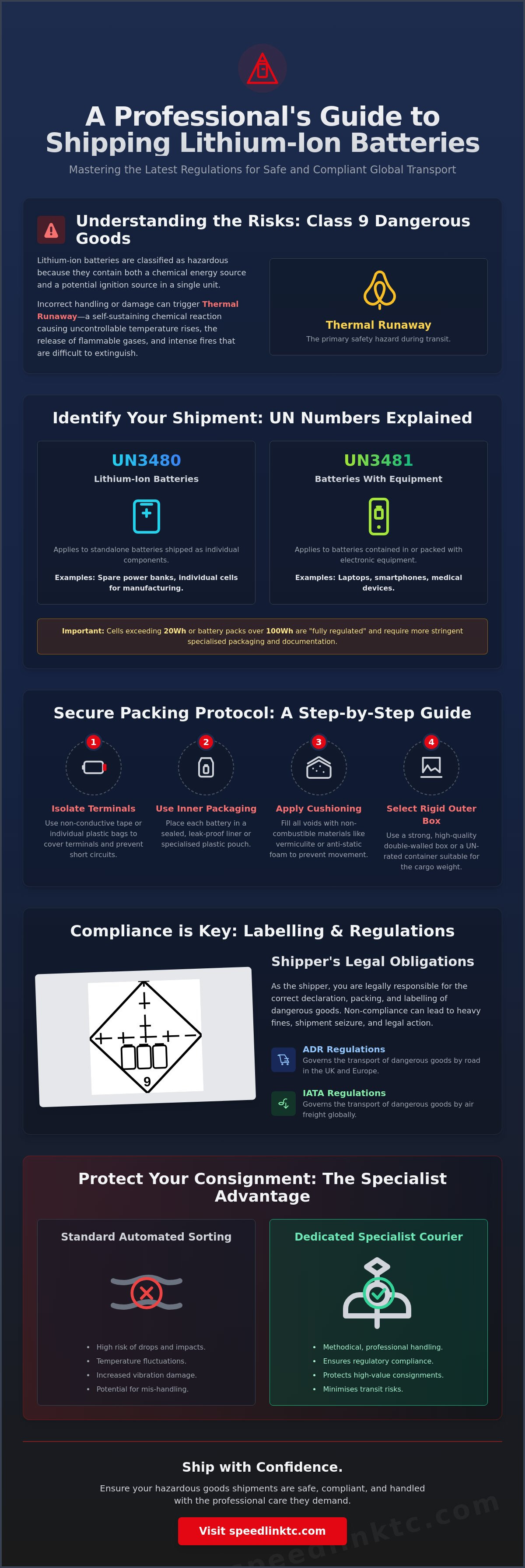
Lithium batteries are classified as Class 9 Miscellaneous Dangerous Goods because they present a unique set of risks that don’t fit into other hazard categories. Unlike standard cargo, these batteries contain both a chemical energy source and a potential ignition source. This dual nature means they’re capable of generating significant heat and fire if they’re damaged or incorrectly handled during transit. Understanding Lithium Ion Batteries is essential for any logistics professional, as the chemistry involved requires specific containment strategies to mitigate risk.
The primary safety concern is a phenomenon known as thermal runaway. This occurs when an internal short circuit or external physical damage causes the battery temperature to rise uncontrollably. This heat triggers a self-sustaining chemical reaction that releases flammable gases and can lead to intense fires that are notoriously difficult to extinguish with standard equipment. It’s also vital to distinguish between lithium-ion cells, which are rechargeable and found in modern electronics, and lithium-metal cells, which are non-rechargeable and contain metallic lithium. While UN3480 applies to standalone lithium-ion batteries shipped as individual components, UN3481 is reserved for batteries that are either contained within equipment or packed with it in the same outer packaging.
Identifying Your Shipment: UN3480 vs UN3481
Determining which classification applies is the first step in learning how to ship lithium ion batteries safely and legally. If you’re sending a smartphone with the battery already installed, the consignment falls under UN3481. However, if you’re shipping spare power banks or individual cells, you must declare them as UN3480. Your technical team must also verify the Watt-hour (Wh) rating of each unit. Lithium-ion cells exceeding 20Wh, or battery packs exceeding 100Wh, are considered “fully regulated” and require more stringent specialised packaging and documentation than smaller consumer-grade equivalents.
Legal Obligations for UK Shippers
Compliance with dangerous goods regulations is a strict legal requirement for all UK businesses. Road transport is governed by the ADR framework, whilst air freight must adhere to the IATA Dangerous Goods Regulations. The shipper holds the ultimate legal responsibility for the correct declaration, labelling, and packing of the goods. If you don’t comply, your business faces the risk of heavy fines, shipment seizure, or even criminal prosecution in the event of an incident. Engaging a lithium battery courier service provides the methodical control needed to ensure your high-stakes shipments reach their destination without regulatory delay. Organisations that also transport biological specimens alongside electronic equipment will find that the same rigorous ADR compliance principles apply to a specialist UN3373 courier service for Category B infectious substances.
How to Pack Lithium Ion Batteries: A Step-by-Step Guide
Packing is the critical physical barrier that prevents a chemical risk from becoming a catastrophic event. If you are refining your internal protocols for how to ship lithium ion batteries, you must adopt a multi-layered approach to containment. Every component of the packaging must be designed to withstand the vibrations, stacking pressures, and temperature fluctuations common in global logistics. If you’re sending high-value electronics, don’t leave the packing to chance.
- Isolate the terminals: Use non-conductive tape, such as electrical tape, or individual plastic bags to ensure terminals cannot touch other batteries or conductive surfaces.
- Use inner packaging: Place the protected batteries inside a leak-proof inner liner or a specialised plastic pouch to contain any potential electrolyte leakage.
- Apply non-combustible cushioning: Fill all voids with materials like vermiculite or specialised anti-static foam to prevent any movement within the box.
- Select rigid outer packaging: Use a high-quality, double-walled corrugated box or a UN-rated container depending on the battery capacity and weight.
Terminal Protection and Short-Circuit Prevention
Exposed terminals are the leading cause of transit fires amongst electronic shipments. If a terminal comes into contact with another battery or a metal object, it can trigger a short circuit, leading to rapid heating. We recommend taping terminals in a way that doesn’t damage the battery casing whilst ensuring they remain completely covered. Following the IATA Lithium Battery Shipping Regulations is the most reliable way to ensure your terminal protection meets international air freight standards.
Inner vs Outer Packaging Requirements
The inner packaging acts as the primary containment layer for heat or fluids. For sensitive consignments, such as IT equipment transport UK, we often utilise specialised crates that provide superior structural integrity compared to standard cardboard. Whilst double-walled boxes are sufficient for many consumer-grade items, high-capacity batteries usually require UN-certified packaging that has been rigourously tested for drop impacts and stacking strength. If you’re unsure which packaging grade your shipment requires, our team can provide a tailored assessment to ensure full compliance and safety.
Labelling and Documentation for Hazardous Shipments
Labelling is more than a mere formality; it’s a vital safety communication for every handler in the supply chain. When you’re determining how to ship lithium ion batteries under the latest 2026 standards, you must use the updated Lithium Battery Mark. A significant change in the 2026 regulations is the removal of the requirement for a telephone number to be displayed on this mark. The standard dimensions remain 100mm x 100mm, though these can be reduced to 100mm x 70mm for smaller packages where space is limited. These visual cues allow logistics personnel to identify risks instantly and follow the IATA guidelines on shipping lithium batteries to ensure safe handling.
In addition to the battery mark, shipments may require the Class 9 ‘Miscellaneous Dangerous Goods’ diamond, which features black vertical stripes on the top half. If you’re sending standalone batteries (UN3480) via air freight, you must also apply the ‘Cargo Aircraft Only’ (CAO) label. This is because bulk lithium shipments are strictly prohibited on passenger planes due to the risk of fire suppression systems being overwhelmed. Every label serves as a directive that dictates how the cargo is stacked, stored, and transported.
Correct Label Placement on Outer Packaging
Labels must be applied to a single flat surface of the outer packaging. You should never fold a hazard label over an edge or a corner, as this makes the symbols and barcodes unreadable for automated scanners and safety inspectors. If your facility reuses boxes, you’re legally required to remove or completely cover any old or irrelevant hazard markings. Leaving an old ‘Flammable Liquid’ sticker on a battery shipment is a guaranteed way to have your consignment seized or destroyed by transit authorities.
The Paperwork Trail: DGNs and Consignment Notes
The Dangerous Goods Note (DGN) is the definitive legal document that accompanies your shipment. It must clearly state the UN number, the proper shipping name, and the total weight of the batteries. For air freight, the DGN must also confirm that the batteries are at a State of Charge (SoC) not exceeding 30%, a mandate that became mandatory for UN3481 as of January 1, 2026. If you’re managing EU shipping with customs clearance, accurate documentation is the only way to avoid lengthy border delays. If you require expert assistance with complex hazardous goods paperwork, contact our dangerous goods specialists to ensure your consignment remains fully compliant.
Choosing the Right Courier: Why Specialist Handling Matters
Selecting a logistics partner is the final, most critical step in determining how to ship lithium ion batteries with absolute safety. Many businesses mistakenly rely on standard ‘hub-and-spoke’ networks, where parcels are subjected to automated sorters and frequent mechanical handling. These high-speed environments increase the risk of physical impact, which can compromise even the most robust packaging. For high-capacity or high-value consignments, a dedicated vehicle is the only way to ensure your cargo remains isolated from incompatible hazards and is moved with methodical care.
A true specialist lithium battery courier service provides more than just transport; they provide ADR-trained drivers who possess the technical knowledge to respond effectively to a battery incident. These professionals understand the nuances of Class 9 goods and ensure that every safety protocol is followed from the moment of collection to the point of delivery. When the stakes involve potential thermal runaway, you don’t want to leave your reputation in the hands of generalist parcel carriers who lack the specific expertise required for hazardous cargo.
Shipping Damaged, Defective, or Recalled Batteries
Damaged, defective, or recalled (DDR) batteries represent a ‘Critical Risk’ and are strictly prohibited from standard air and road networks. If a battery shows any signs of swelling, leakage, or physical deformation, it requires specialised containment and immediate expert intervention. You must use a dedicated lithium battery courier service for these movements. Standard couriers will refuse these shipments because they pose a significant fire hazard to other cargo and personnel. We manage these high-stakes scenarios by providing the technical oversight and specialised equipment necessary to transport compromised cells safely.
The SpeedLink Approach to Battery Logistics
We provide a reassuring sense of calm in high-stakes situations by utilising dedicated vehicles for all sensitive battery movements. By avoiding parcel hubs entirely, we eliminate the primary source of transit damage and ensure your consignment stays under our direct control. Whether you are managing a complex industrial rollout or require an international same day courier for an urgent tech deployment, our precision-led processes guarantee that your requirements are handled by seasoned experts. We act as your strategic partner, ensuring that your business remains compliant whilst maintaining the speed and reliability your operations demand.
Securing Your High-Stakes Battery Consignments
Mastering the technical nuances of dangerous goods transport is a prerequisite for any modern business dealing with high-value technology. Correctly identifying UN classifications and adhering to the 2026 labelling standards eliminates the risk of regulatory friction and shipment delays. Physical safety relies on meticulous terminal protection and the use of robust, UN-rated packaging to prevent thermal runaway during transit. These methodical steps create a secure framework for your global supply chain and ensure your cargo remains compliant at every checkpoint.
When you’re deciding how to ship lithium ion batteries, the choice of logistics partner is the final safeguard for your operational integrity. Dedicated vehicle transport removes the inherent dangers of automated parcel hubs; it ensures your cargo is handled exclusively by experts who value precision. Our ADR-trained drivers bring a methodical sense of control to every movement, drawing on deep expertise in high-value IT and industrial logistics to protect your assets. We position ourselves as a strategic advisor to ensure your requirements are handled with global capability.
If you require a partner that understands the precision required for hazardous goods, we’re ready to facilitate a solution. Book a Specialist Lithium Battery Courier with SpeedLink today to ensure your next shipment is handled with authoritative care. Your compliance and safety are our shared mission.
Frequently Asked Questions
Can I ship lithium ion batteries in the mail in the UK?
Standard postal services in the UK only permit lithium-ion batteries when they are contained within or packed with a device. You cannot send standalone power banks or individual replacement cells through the regular mail network as these are classified as prohibited items. If your business needs to move loose batteries or high-capacity units, you should utilise a specialist Dangerous Goods Courier to ensure the consignment remains compliant with ADR road safety regulations.
What happens if I ship lithium batteries without declaring them?
Failing to declare hazardous cargo is a serious legal violation that often leads to shipments being seized, quarantined, or destroyed by transit authorities. If an undeclared battery causes a fire or safety incident, the shipper faces heavy financial penalties and potential criminal prosecution under international transport laws. We recommend a methodical approach to documentation to ensure your business stays protected from these severe operational and legal risks.
Is there a limit on the number of batteries I can ship in one box?
Quantity limits depend on the Watt-hour (Wh) rating of the batteries and whether they are standalone or contained within equipment. For standalone batteries classified as UN3480, strict weight and quantity restrictions apply per package to manage the aggregate fire risk during transit. If you are unsure how to ship lithium ion batteries in bulk, our team can help you determine the specific thresholds for fully regulated shipments under current IATA and ADR frameworks.
Do I need a special box to ship a laptop with a lithium battery?
You don’t always require a UN-certified container for a single device, but you must use a rigid, high-quality outer box that prevents the laptop from moving. It’s vital to ensure the device cannot be accidentally activated; this involves shielding the power button and ensuring the laptop is completely powered down. For high-value deployments, our Laptop Courier Services provide the specialised structural protection needed to prevent damage and ensure safety throughout the journey.
How do I ship a swollen or damaged lithium battery safely?
You must never ship a swollen, leaking, or physically compromised battery through standard road or air networks because they represent a critical fire risk. These units are generally prohibited from regular transport and require specialised pressure-relief packaging and dedicated vehicle collection. If you identify a battery showing signs of thermal distress, isolate it in a non-combustible container and contact a specialist hazardous goods partner to arrange a secure, ADR-compliant movement immediately.

Article by
Dave McMillen
I have worked in courier and logistics for over 30 years. My experience spans two continents and several types of services from road freight to airlines and specialist B2B services. SpeedLink has been serving the UK market for over 20 years providing the finest time critical and specialist services supporting businesses and individuals alike.
Disclaimer
Information is provided as general logistics guidance and is not legal, customs, aviation, medical or dangerous-goods compliance advice.
Rules vary according to commodity, quantity, classification, packaging, origin, destination, transport mode and carrier.
Regulations and carrier requirements may change.
Where regulated goods are involved, current requirements should be confirmed with the appropriate government authority, regulator, carrier or qualified specialist before shipment.
SpeedLink can confirm the transport options it can provide for a particular shipment.


