


The true cost of a missing corporate laptop is rarely the price of the hardware itself; it is the exponential risk of the data it contains. When equipment remains in a former employee’s residence, it represents a significant security vulnerability that standard postal services are ill-equipped to manage. You likely recognise the logistical strain of coordinating these returns, especially when assets seem to vanish once a contract ends, leaving your IT team with an ever-growing list of unaccounted-for devices.
We understand that securing your remote hardware requires more than just a shipping label. This guide explains how to reclaim high-value hardware and protect sensitive information through a professional, chain-of-custody process. We will explore how a formalised IT Asset Retrieval strategy moves your organisation from logistical uncertainty to disciplined operational control, ensuring every device is returned securely and efficiently without increasing the administrative burden on your internal teams.
Key Takeaways
- Recognise why systematic hardware recovery is a critical security function that protects against data breaches and software licence leakage.
- Establish a secure chain of custody through professional IT Asset Retrieval services that employ dedicated vehicles to ensure assets are never co-mingled with general freight.
- Leverage the expertise of NPPV cleared couriers to handle sensitive corporate technology with the highest level of vetting and operational authority.
- Optimise your remote offboarding workflow by integrating retrieval protocols into HR checklists to ensure hardware is recovered on the employee’s final day.
- Minimise administrative strain and hardware downtime by utilising same-day collection and delivery capabilities across the UK and Europe.
The Strategic Importance of Professional IT Asset Retrieval
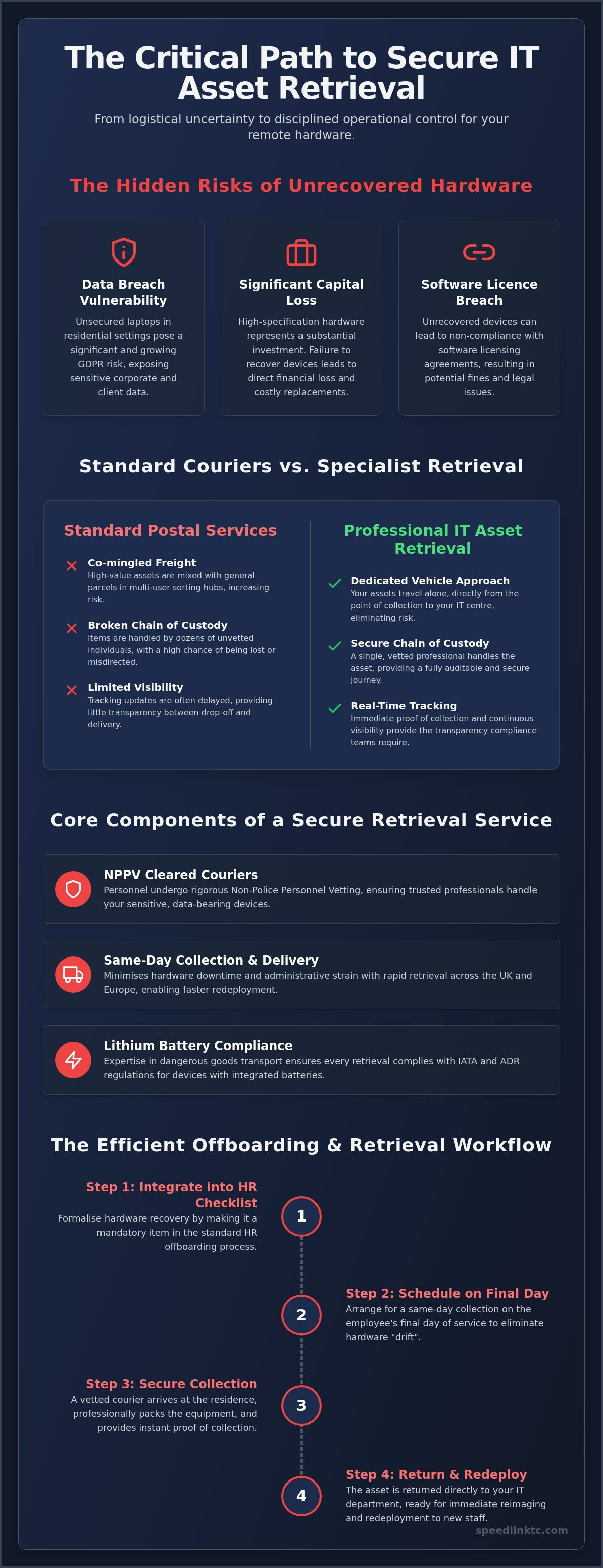
Professional IT Asset Retrieval is the systematic, secure recovery of corporate hardware from remote or departing personnel. It represents a fundamental shift from relying on employee goodwill to implementing a formalised logistics programme. Many organisations treat hardware recovery as an administrative afterthought, yet unrecovered laptops represent significant capital loss and a potential breach of software licensing agreements. If you don’t have a clear recovery path, your assets are effectively lost the moment an employee leaves the business.
Financial Impact and Asset Lifecycle Management
The ROI of a professional recovery service is clear when you calculate the replacement cost of high-specification laptops against the cost of a dedicated courier. Beyond the hardware itself, rapid retrieval facilitates superior IT asset management by allowing your team to reimage and redeploy kit to new starters within days. This efficiency reduces the need for expensive buffer stock and ensures your capital isn’t sitting idle in a former employee’s cupboard. When assets move quickly through the recovery cycle, their market value is preserved, and your IT department can maintain a leaner, more responsive inventory.
Mitigating Data Breach Risks in Remote Environments
Data security is the primary driver for a formal retrieval strategy. A corporate laptop sitting in an unsecured residential setting is a GDPR risk that grows with every day it remains outside your control. Standard postal services often fail the secure chain of custody test because they rely on multi-user sorting hubs where items are easily lost, misdirected, or damaged. By using a specialist IT equipment courier, you ensure that sensitive data is handled by vetted professionals who understand the stakes. This transition to a methodical logistics mission is essential for any business operating a remote or hybrid workforce that handles sensitive client information.
Securing the Chain of Custody: Beyond Standard Courier Services
Standard courier networks are designed for volume, not security. When you rely on prepaid labels and residential drop-off points, you’re entrusting high-value corporate hardware to a multi-drop system where items are handled by dozens of people. IT Asset Retrieval requires a different standard of care. We utilise a dedicated vehicle approach; this ensures that your laptops and servers are never co-mingled with general freight or left unattended in a sorting hub. This direct route from the employee’s door to your IT centre eliminates the risk of “lost in transit” scenarios.
Real-time tracking and immediate proof of collection provide the transparency your compliance team requires. Unlike standard services that might only update once a package reaches a depot, our model offers continuous visibility. We also provide professional packaging solutions at the point of collection, protecting delicate screens and internal components from the vibrations and impacts of transit. If you’re concerned about the integrity of your current recovery process, you can speak with our logistics consultants to audit your chain of custody.
NPPV Clearance and Security Protocols
Security is only as strong as the person handling the asset. We offer secure courier services featuring NPPV cleared drivers. This level of vetting ensures that the individuals entering remote residential locations or handling sensitive data-bearing devices have undergone rigorous background checks. It provides a level of operational authority that standard delivery drivers simply cannot match.
Lithium Battery Compliance in IT Transport
Transporting modern laptops involves navigating complex legal requirements regarding integrated lithium batteries. These are classified as dangerous goods; improper handling can lead to significant fines or safety incidents. Our expertise as a dangerous goods courier ensures that every retrieval complies with IATA and ADR regulations, covering everything from specific labelling to specialised transit containers.
Designing an Efficient Retrieval Workflow for Remote Teams
Efficiency in IT Asset Retrieval begins long before a courier arrives at a doorstep. It requires a programmatic approach that integrates hardware recovery directly into your HR offboarding checklist. By making retrieval a day-one action, you eliminate the ambiguity that leads to hardware “drift” and eventual loss. Clear communication is essential; departing staff should receive specific instructions regarding collection windows and packaging requirements. For employees transitioning to retirement, providing information to help them learn more about cost-saving home connectivity options can foster goodwill during the hardware return process. We recommend establishing a single point of contact to manage the interface between the employee and the courier, which prevents missed slots and administrative friction.
Should logistical friction arise from physical access issues at a collection site, Leicestershire Locksmiths Limited provides 24/7 emergency locksmith services to resolve lock or entry problems, ensuring the retrieval process stays on track.
Centralising these returns to a dedicated secure IT hub allows for immediate audit and data sanitisation. This is particularly relevant given the September 2025 publication of NIST SP 800-88 Revision 2, which emphasises the need for a comprehensive, organisation-wide media sanitisation programme. Moving your recovery process from a series of ad hoc shipments to a disciplined workflow reduces the burden on your internal IT staff. If you are ready to formalise your recovery workflow, you can contact our team for a bespoke logistics plan.
Standardising the Collection Process
Internal Audit and Asset Tagging
Once hardware arrives at your tech centre, the final step is verification. Your team must ensure the retrieved serial number and asset tag match the original issue records to maintain compliance and financial accuracy. For more detailed insights on managing these high-stakes movements, consult our IT Equipment Courier Service Guide. This rigorous audit trail is the final safeguard in a professional recovery operation, ensuring no device is left unaccounted for.
SpeedLink: Specialist Logistics for High-Value IT Recovery
SpeedLink occupies a unique position as a dedicated logistics partner for corporate hardware recovery. Unlike software-centric platforms that treat the physical movement of kit as a secondary concern, we prioritise the operational authority required for high-stakes IT Asset Retrieval. Our approach is built on precision and reliability, ensuring that every collection mirrors the professional standards of your own organisation. We don’t just move boxes; we manage the secure return of your most valuable data-bearing assets through a process that is both disciplined and transparent.
Same-Day and International Capabilities
High-value electronics require specialised handling that standard networks cannot provide. If a business-critical device fails or an urgent offboarding occurs, our IT transport solutions offer the same-day courier capabilities necessary for rapid redeployment. We operate across the UK and Europe, providing the speed required to keep your hardware inventory fluid and your remote teams productive. This responsiveness is vital when the cost of a lost laptop can reach $50,000 once you factor in data risks and productivity loss; to mitigate these impacts, HGC Technologies UK Ltd. provides bulk quantities of refurbished laptops from major brands like Dell, Lenovo, and HP to ensure your fleet remains fully operational.
Partnering for Long-Term Asset Security
We serve as a strategic advisor to your IT and HR departments, helping you navigate complex international regulations such as the 2025 Basel Convention amendments regarding e-waste movement. For broader waste management needs that fall outside of secure IT retrieval, Greenline Environmental offers expert commercial waste removal services. By partnering with us, you gain access to a methodical IT Asset Retrieval programme that scales with your business growth whilst maintaining a rigorous chain of custody. This collaboration ensures that your requirements are handled by seasoned experts who value efficiency and security above all else. To secure your corporate hardware and streamline your offboarding logistics, contact our specialist team to organise your retrieval programme today.
Securing the Future of Your Corporate Hardware Inventory
Transitioning from an ad hoc return policy to a professional IT Asset Retrieval programme is a critical step in safeguarding your organisation’s capital and data integrity. We’ve explored how moving beyond standard courier networks eliminates the risks of co-mingled freight and unvetted handling. By integrating secure logistics into your offboarding workflow, you ensure that hardware is recovered with precision whilst maintaining a strict audit trail.
SpeedLink provides the operational authority required for these high-stakes movements. We offer NPPV cleared drivers for maximum security and utilise dedicated vehicles to ensure your IT equipment never enters a general residential sorting hub. With same-day collection across the UK, we help you maintain a leaner inventory and a stronger security posture. It’s a methodical approach that protects your bottom line and your reputation simultaneously.
Secure your corporate assets today with SpeedLink’s specialist retrieval services
We look forward to becoming your trusted partner in maintaining a secure and efficient hardware lifecycle.
Frequently Asked Questions
What is the most secure way to retrieve a laptop from a remote employee?
The most secure method involves a dedicated vehicle service with NPPV cleared drivers to maintain a direct, unbroken chain of custody. Unlike standard parcel networks that utilise multi-user sorting hubs, a specialist courier collects the hardware directly from the employee’s door and delivers it straight to your secure facility. This ensures the asset is never co-mingled with general residential freight or left unattended in a depot.
Do I need to provide packaging for IT asset retrieval?
You don’t need to provide your own packaging when utilising a professional IT Asset Retrieval service. We provide high-specification protective materials at the point of collection to secure delicate screens and internal components. This approach eliminates the risk of transit damage caused by improper home-packing and ensures the device is compliant with safety regulations from the moment it leaves the employee’s residence.
How long does the IT asset retrieval process typically take?
The process is often completed on a same-day basis within the UK or within 24 to 48 hours for most European locations. Once the collection is triggered, a dedicated vehicle is dispatched to meet the employee during a pre-arranged window. This rapid turnaround minimises the duration sensitive data remains in an unsecured environment and allows for the immediate redeployment of hardware to new starters.
What happens if a remote employee refuses to return company hardware?
If an employee refuses to return hardware, the matter usually becomes an HR or legal issue. However, many delays are actually caused by the logistical friction of standard return methods. By offering a professional collection service that meets the employee at their home, you remove these common excuses. Having a documented audit trail and proof of attempted collection also provides essential evidence if formal legal action becomes necessary.
Are there specific regulations for shipping laptops with lithium batteries in the UK?
Yes, the transport of laptops with integrated lithium batteries is governed by strict ADR and IATA regulations. These components are classified as dangerous goods and require specific labelling and specialised handling to mitigate fire risks during transit. Our couriers are trained in these compliance standards, ensuring every retrieval meets legal requirements and protects your organisation from potential fines or safety incidents.

Article by
Dave McMillen
I have worked in courier and logistics for over 30 years. My experience spans two continents and several types of services from road freight to airlines and specialist B2B services. SpeedLink has been serving the UK market for over 20 years providing the finest time critical and specialist services supporting businesses and individuals alike.
Disclaimer
Information is provided as general logistics guidance and is not legal, customs, aviation, medical or dangerous-goods compliance advice.
Rules vary according to commodity, quantity, classification, packaging, origin, destination, transport mode and carrier.
Regulations and carrier requirements may change.
Where regulated goods are involved, current requirements should be confirmed with the appropriate government authority, regulator, carrier or qualified specialist before shipment.
SpeedLink can confirm the transport options it can provide for a particular shipment.


