


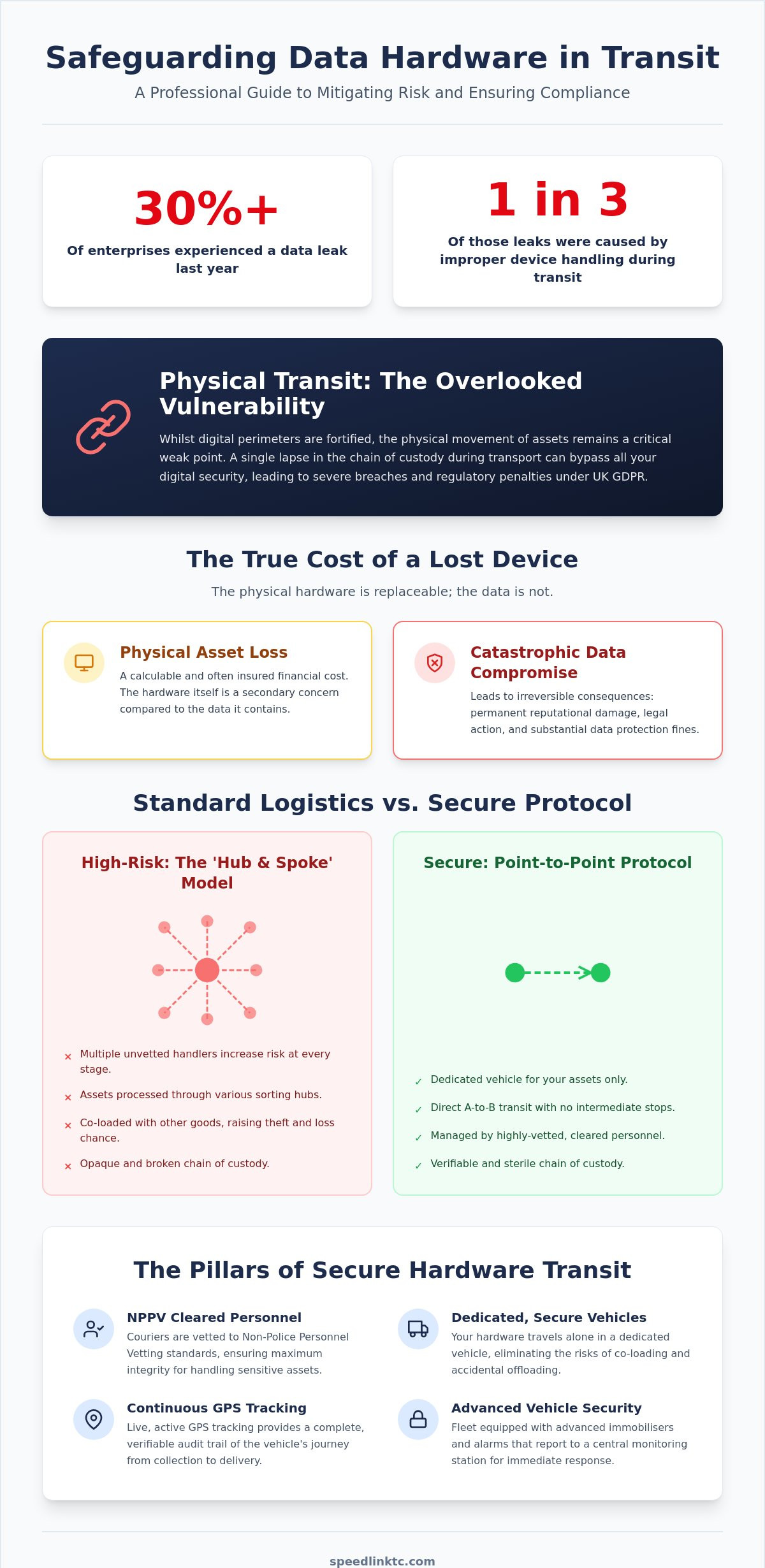
Did you know that over 30% of enterprises experienced a data leak last year, with a staggering third of those breaches caused by the improper handling of devices during redeployment or transit? When you’re transporting sensitive data hardware, the stakes extend far beyond simple logistics. You’re managing a critical compliance function where any lapse can result in severe GDPR fines and irreparable reputational damage if a single drive goes astray.
We recognise the anxiety that comes with handing over your organisation’s most sensitive assets, particularly when uncertainty exists regarding the vetting of courier staff or the physical security of the vehicle. This 2026 guide will demonstrate how to safeguard your assets using professional protocols that guarantee a secure chain of custody and strict adherence to UK data protection standards. We’ll examine the industry shift to NIST 800-88 sanitisation, the implications of the EU Data Act, and the methodical steps required to ensure your hardware arrives safely and compliantly. By the end of this article, you’ll have a clear framework for managing high-stakes movements with total operational confidence.
Key Takeaways
- Identify the specific vulnerabilities that make physical transit the weakest link in your organisation’s security infrastructure.
- Understand why NPPV cleared personnel and dedicated vehicle transport are essential protocols for maintaining a verifiable chain of custody.
- Implement a professional preparation checklist covering inventory serialisation and data sanitisation to secure assets before they are moved.
- Discover the strategic advantages of utilising a specialist courier for transporting sensitive data hardware to ensure compliance with UK data protection standards.
- Learn how to balance speed and security to minimise the exposure window for critical hardware, from individual laptops to entire data centres.
The Critical Risks of Transporting Sensitive Data Hardware
In a landscape where digital perimeters are increasingly fortified, the physical movement of assets remains a significant vulnerability. Sensitive data hardware encompasses more than just generic IT equipment. It includes enterprise-grade servers, solid-state drives containing proprietary algorithms, and corporate laptops housing sensitive intellectual property. Whilst your internal network may be secured by sophisticated encryption, the act of transporting sensitive data hardware introduces a physical dimension of risk that software alone cannot mitigate.
To complement physical security measures, organisations can discover Quantum Infinity and their specialised Quantum Live Mask (QLM®) solution for keyless stealth tunneling.
Logistics operations often represent the weakest link in a security strategy. Many organisations mistakenly rely on standard multi-drop networks where assets are processed through various sorting hubs. This “hub and spoke” model significantly increases the probability of loss or theft as items are handled by multiple unvetted individuals. Given the inherent risks of removable media and portable storage, a single lapse in the chain of custody can lead to a catastrophic breach. Under UK GDPR, the Information Commissioner’s Office (ICO) views hardware in transit as a high-risk processing activity, requiring rigorous physical safeguards to avoid substantial fines.
Physical Theft vs. Data Compromise
The financial loss of a physical server or laptop is often a secondary concern compared to the value of the information residing on its drives. A stolen device is a replaceable asset, but compromised data can lead to permanent reputational damage and legal action. The “breach window” is the critical interval between the physical loss of hardware and the successful execution of a remote data wipe or the compromise of local encryption. If this window is left open due to poor transit protocols, the consequences are often irreversible.
The Regulatory Burden in 2026
The UK data protection landscape in 2026 demands a proactive approach to physical security. Compliance is no longer just about digital firewalls; it requires a verifiable audit trail for every asset that leaves your building. Failing to utilise secure courier services for high-sensitivity movements can be interpreted as a failure to implement “reasonable” organisational measures. We see a growing trend where regulators scrutinise the vetting levels of third-party staff, making the choice of transport partner a strategic security decision rather than a simple procurement task.
Essential Security Protocols for Hardware in Transit
Mitigating the risks identified previously requires a transition from standard logistics to specialised security protocols. When transporting sensitive data hardware, the objective is to maintain a sterile chain of custody where the asset is never left unattended or exposed to unvetted third parties. This is achieved through a combination of rigorous personnel screening and dedicated transport methods that eliminate the vulnerabilities inherent in general freight networks.
Vetted Couriers and the Human Element
The integrity of your data often rests with the individual behind the wheel. Standard delivery drivers typically undergo basic background checks, but these are insufficient for high-stakes IT assets. We ensure maximum security by utilising NPPV cleared courier services. Non-Police Personnel Vetting (NPPV) is a robust clearance level used for those working with the police or handling sensitive government data. This level of scrutiny provides peace of mind that the personnel managing your hardware have been vetted to the highest national standards.
Vehicle Security and Environmental Controls
Physical security extends to the vehicle itself. Dedicated transport means your hardware isn’t “co-loaded” with unrelated commercial goods, which significantly reduces the risk of accidental offloading or theft. Every vehicle used for transporting sensitive data hardware must be equipped with active GPS tracking, advanced immobilisers, and alarm systems that report directly to a central monitoring station. For complex server components, we also address the need for climate-controlled environments to prevent hardware degradation caused by temperature fluctuations during transit.
Point-to-point logistics ensure that once your assets are loaded, the vehicle travels directly to the destination without stopping at intermediate hubs. This creates a transparent audit trail, providing the documented proof of custody required for your compliance records. If you’re planning a critical move, you can speak with our security consultants to tailor a protocol that fits your specific data sensitivity level.
A Manager’s Checklist for Preparing Secure IT Assets
Successful transit begins long before the vehicle arrives. For IT managers, the preparation phase is where the foundation for a secure chain of custody is laid. When transporting sensitive data hardware, your internal processes must be as disciplined as the logistics themselves to ensure no gaps exist for exploitation.
- Inventory and Serialisation: Record every asset by its serial number and classify it by data sensitivity. If a shipment contains twelve drives, exactly twelve must be verified at every stage.
- Data Sanitisation: Ensure all drives are encrypted. In 2026, the industry standard is NIST SP 800-88 Revision 2. If data isn’t required at the destination, purge it entirely to minimise the potential impact of a physical breach.
- Blind Labelling: Avoid using descriptive labels like “High-Value IT” or “Encrypted Server”. These act as beacons for opportunistic thieves. Use plain, tamper-evident packaging with numerical coding that only your team and the courier can cross-reference.
- Pre-Transit Audit: Conduct a final sign-off between your IT lead and the courier. This formalises the start of the chain of custody and ensures both parties agree on the state and count of the assets.
The Art of Secure Packaging
Standard cardboard is insufficient for data-heavy hardware. We recommend utilising Peli-cases or custom-built crates for fragile server racks and high-density storage arrays. These containers should be secured with tamper-evident seals that provide immediate visual evidence of interference. These seals ensure that any attempt to access the hardware is documented the moment it reaches its destination.
Documentation and Legal Compliance
A robust “Transfer of Custody” document is essential for satisfying both internal auditors and UK GDPR requirements. This documentation must track the asset from the server room to the delivery point. Our specialised IT Transport Solutions are designed to provide this level of granular detail, ensuring your organisation remains compliant with the latest data protection standards. If you need to arrange a secure movement for critical hardware, contact our specialist team today to discuss your requirements.
Why Specialist B2B Couriers are the Logical Choice
Selecting a logistics partner for high-value technology isn’t merely a procurement decision; it’s a strategic risk management choice. General couriers operate on volume and efficiency, which often conflicts with the meticulous care required for transporting sensitive data hardware. Specialist B2B providers understand that every minute an asset is in transit is a minute of potential exposure. By utilising a dedicated vehicle, we eliminate the delays and handling risks associated with sorting hubs, ensuring your hardware remains in a controlled, secure environment from start to finish.
Precision is the hallmark of a specialist. Whether you’re moving a single encrypted drive or an entire data centre’s worth of racks, the transport plan must be bespoke. We don’t just move boxes; we manage a secure transition. This includes tailoring the route, the vehicle’s security features, and the vetting level of the personnel involved. This level of operational authority is why organisations trust us as their strategic partner for IT equipment courier services.
Urgent Hardware Deployments
When a server fails or a remote executive requires an immediate laptop replacement, time is of the essence. Our Same Day Courier service maintains business continuity by bridging the gap between security and speed. We act as a proactive guide, ensuring that urgent deployments don’t bypass security protocols in the name of haste. By reducing the “exposure time” in transit, we significantly lower the risk profile of the entire movement.
Mitigating the ‘Employee Drive’ Risk
It’s tempting to ask an employee to move a laptop or server in their personal vehicle, but this creates significant liability gaps. Standard motor insurance rarely covers corporate assets, and personal vehicles lack the security features, such as immobilisers and active GPS tracking, found in professional fleets. When transporting sensitive data hardware, professional indemnity and specialised goods-in-transit insurance are non-negotiable. We provide the financial protection and methodical control necessary to ensure that your organisation isn’t left exposed to crippling legal consequences. Professional handling isn’t just about safety; it’s about peace of mind for the decision-makers responsible for the data.
Securing Your Organisation’s Future with Professional Data Logistics
Transitioning from identifying risks to implementing solutions requires a shift in operational mindset. We’ve established that physical transit shouldn’t be the weak point in your security architecture. By adopting professional protocols such as Non-Police Personnel Vetting and dedicated vehicle transport, you transform a potential vulnerability into a controlled, compliant process. When transporting sensitive data hardware, the margin for error is non-existent; every movement must be backed by a verifiable chain of custody and expert handling.
Our approach combines the urgency of same-day logistics with the precision of a strategic security advisor. As specialists in high-value IT logistics, we provide dedicated point-to-point vehicles and NPPV security cleared drivers to protect your most critical assets. Don’t leave your organisation’s reputation to chance with unvetted networks or multi-drop couriers. It’s time to ensure your hardware is handled with the methodical control it deserves.
Book a Secure NPPV Cleared Courier for Your Critical Hardware and maintain total operational confidence during your next deployment.
Frequently Asked Questions
What is the safest way to transport hard drives containing sensitive data?
The safest method is utilising dedicated, point-to-point transport that bypasses sorting hubs entirely. This approach ensures your equipment remains in a single vehicle under the constant supervision of a security-cleared professional. By eliminating the risks associated with co-loading and manual handling at distribution centres, you significantly reduce the physical threat vector during the logistics cycle.
Does GDPR require me to use a specialised courier for hardware?
UK GDPR does not explicitly mandate a specific type of courier, but it does require “appropriate technical and organisational measures” to ensure data security. If a breach occurs whilst transporting sensitive data hardware via a standard parcel network, the Information Commissioner’s Office may determine that you failed to exercise due diligence. Using a specialised provider demonstrates a proactive commitment to risk mitigation that aligns with regulatory expectations.
What is an NPPV cleared courier and why does my business need one?
An NPPV cleared courier has undergone Non-Police Personnel Vetting, a rigorous screening process used by UK police forces to verify the integrity of contractors. This vetting checks an individual’s criminal record, financial history, and residency to a much higher standard than a basic DBS check. Your business needs this level of clearance to ensure that individuals handling your most critical intellectual property have been verified by national security standards.
Should I encrypt hardware before it is collected for transport?
Yes, full-disk encryption should be active on all devices before they leave your premises. Encryption acts as your final line of defence if physical security is compromised. It’s also vital to transport any physical decryption keys or authentication tokens separately from the hardware to ensure that a thief cannot access the data even if they obtain the physical device. For organisations looking to upgrade their physical security infrastructure, London Locks – Locksmiths Keys and Fobs. offers expert advice on high-security keys and access control.
How do I track my sensitive hardware during transit?
Tracking is achieved through active GPS monitoring and a formalised chain of custody. When transporting sensitive data hardware, we provide real-time updates and can implement geofencing alerts that trigger if a vehicle deviates from its pre-approved route. This digital oversight is paired with physical signatures at every handover point, creating a comprehensive audit trail that satisfies both internal security policies and external regulatory requirements.

Article by
Dave McMillen
I have worked in courier and logistics for over 30 years. My experience spans two continents and several types of services from road freight to airlines and specialist B2B services. SpeedLink has been serving the UK market for over 20 years providing the finest time critical and specialist services supporting businesses and individuals alike.
Disclaimer
Information is provided as general logistics guidance and is not legal, customs, aviation, medical or dangerous-goods compliance advice.
Rules vary according to commodity, quantity, classification, packaging, origin, destination, transport mode and carrier.
Regulations and carrier requirements may change.
Where regulated goods are involved, current requirements should be confirmed with the appropriate government authority, regulator, carrier or qualified specialist before shipment.
SpeedLink can confirm the transport options it can provide for a particular shipment.


