


A shipment rarely succeeds on transport alone. Specialist freight logistics coordinates inbound and outbound movements alongside shipment planning, transport, warehouse and inventory operations, and international customs requirements. The logistics specialist keeps these activities aligned, responds when plans change and maintains visibility of the shipment’s progress.
That coordination matters because a delay, incomplete document or mismatch between delivery and receiving arrangements can disrupt the wider operation. The right transport method also depends on the cargo, route, timing and handling requirements, so not every shipment needs the same solution.
This article explains what logistics specialists do, how they manage shipments from collection through delivery, and how warehouse, inventory and customs coordination fit in. It also outlines how to assess transport options, including road and freight services and time-critical arrangements, so you can understand what a well-managed shipment involves.
Key Takeaways
- Coordinate collections, receiving arrangements and handovers to keep inbound and outbound shipments moving when plans change.
- Match transport modes to the cargo, route and operational priorities rather than defaulting to one method.
- Use shipment records, inventory visibility and delivery evidence to identify delays, shortages and points needing attention.
- Understand how customs paperwork supports international movements, and where specialist courier or freight services can help with time-critical or sensitive consignments.
Inbound and outbound shipment coordination
Inbound coordination aligns supplier collections, receiving capacity and inventory records before goods arrive. Specialist freight logistics teams match delivery details to operational needs. For example, a manufacturer receiving a replacement pump needs the delivery point, site access and production schedule coordinated. Outbound planning confirms order readiness, consignment details, destination access and dispatch timing. These steps connect purchasing, warehouse, transport and distribution teams across complex supply chains.
Responsibilities are shared. A transport coordinator books carriage and tracks the shipment, while warehouse staff prepare goods and confirm they are ready for loading. Procurement or customer service teams communicate order changes and delivery requirements. If a collection is missed, the logistics specialist confirms the shipment is ready before arranging another collection time. Clear ownership prevents conflicting instructions across a global network.
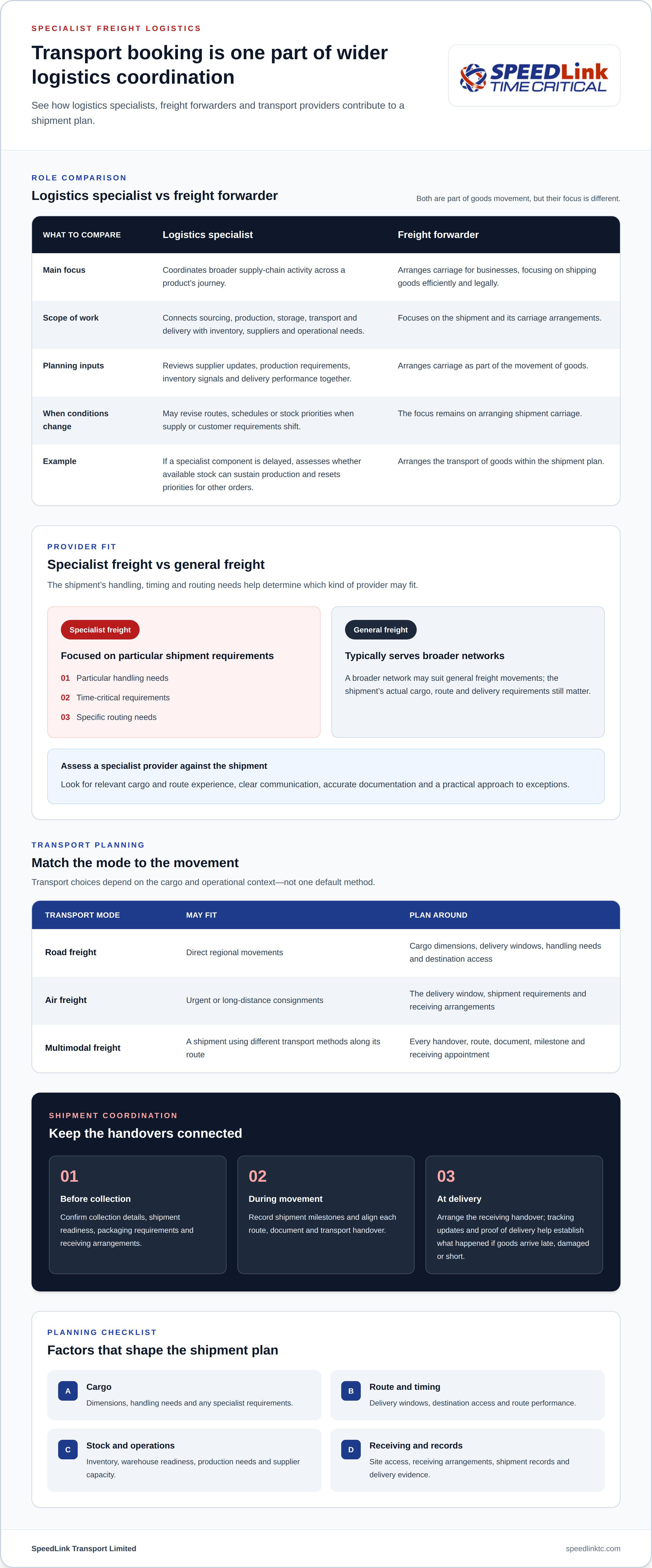
Multimodal freight combines different transport methods within one shipment plan. A consignment might travel by road to a port, by sea, then by road to its destination. Coordinators align each handover, route, document and receiving appointment while tracking milestones throughout. For urgent cargo, an alternative route or transport mode may better suit the delivery window.
Specialist freight companies focus on shipments with particular handling, timing or routing needs, while general freight carriers typically serve broader networks. A specialist freight logistics provider should demonstrate relevant cargo and route experience, clear communication, accurate documentation and a practical approach to exceptions. These factors help businesses judge whether the service suits the shipment’s actual requirements.
Medical, hazardous, oversized and temperature-controlled cargo can call for specialist coordination. A large industrial component, for instance, may need route and site-access planning. Sensitive goods require handling and transport arrangements suited to their characteristics. The cargo type determines the appropriate controls and network.
Pickup, packaging, tracking and delivery are connected stages. The logistics team agrees collection details, establishes packaging requirements, records shipment milestones and arranges the receiving handover. Tracking updates and proof of delivery help establish what happened if goods arrive late, damaged or short.
The U.S. Bureau of Labor Statistics projects U.S. employment of logisticians to grow 18 percent from 2025 to 2035, reflecting the importance of coordinated shipment movement.
Transportation logistics in supply chain management
Transportation logistics connects sourcing, production, storage and delivery through planned goods movement. A transport manager selects routes and modes based on cargo dimensions, delivery windows, handling needs and destination access. For example, a late component can leave an assembly line without a required part. Rerouting may protect production but disrupt other scheduled deliveries.
Supply chain analysis compares forecast demand with stock, supplier capacity, route performance and order history. A planner can use previous sales to identify seasonal shifts in demand, then align purchase orders, carrier space and warehouse labour before dispatch. Forecasts change when suppliers report shortages or customers revise quantities. Technical data-analysis skills can reveal recurring bottlenecks, while accurate master data keeps product codes, lead times and locations consistent. A promotion can also prompt earlier replenishment at regional depots.
Supply chain oversight connects operational decisions to the entire flow, not just transport bookings. A logistics specialist reviews supplier updates, production needs, inventory signals and delivery performance together. If a specialist component is delayed, the planner assesses whether available stock can sustain production. The team can then reset priorities for other orders. This joined-up view supports efficiency because decisions reflect their impact across the network.
Freight forwarders arrange carriage for businesses; logisticians coordinate broader supply-chain activity across a product’s life cycle. A retailer launching a product must align purchasing, inbound transport, stock allocation and outbound distribution. Forecasting turns expected demand into capacity plans. Oversight compares those plans with actual orders and supplier performance. When conditions shift, logistics teams revise routes, schedules or stock priorities instead of treating each movement separately.
That distinction matters when a shipment needs more than a carrier booking: logistics specialists oversee the broader supply chain, while freight forwarders focus on shipping goods efficiently and legally. Logistics specialists coordinate supply-chain activities to keep operations on schedule and under control, placing transport within the wider operational picture. They oversee a product’s journey to help it reach its destination on time, within budget and in good condition.
Coordination matters because transport is part of a wider product journey and supply-chain operation. Planning connects shipment choices with inventory, suppliers and delivery requirements, rather than treating dispatch as an isolated task.
Warehouse, inventory, and transportation operations
Warehouse teams, inventory records and transport plans must align to prevent dispatching unavailable stock. U.S. logisticians held about 255,100 jobs in 2025, according to the U.S. Bureau of Labor Statistics.
Selecting Transport Modes and Routes
Mode and route selection match a shipment’s requirements to a practical transport plan. Road freight suits direct regional movements, while air freight may fit urgent or long-distance consignments. A planner weighs cargo dimensions, handling needs, delivery windows and destination access. For example, a bulky engineering component may require route checks for access constraints. Accurate inventory data also helps warehouse teams coordinate loading and avoid idle vehicle capacity.
Factors Affecting Freight Rates and Delivery Times
Freight rates and delivery times depend on the shipment, route and service requirements. Cargo size, weight, collection location, destination, urgency and handling needs all shape the transport plan. A dedicated movement may reduce handovers, while a consolidated route can involve additional stops. Businesses can balance cost and risk by matching service speed to operational impact. A delayed production part may justify a more direct option than routine replenishment. The right choice depends on the consequences of delay and the cargo’s needs.
Information a business should provide for a specialist freight quote
A useful quote starts with details that let the transport team assess the whole movement. Provide collection and delivery locations, required dates, dimensions, weight, item description, handling needs and any access restrictions. Explain whether goods are ready, how they are packaged and who will receive them. These details help assess route, mode, warehouse coordination and delivery timing. The U.S. Bureau of Labor Statistics reports a median annual wage for logisticians of $82,320 in May 2025. It projects about 26,600 openings for logisticians each year, on average, over the decade from 2025 to 2035.
International shipping and customs
International freight coordination connects transport planning with customs documents and destination requirements. A freight forwarder can arrange carriage and support paperwork for an import or export. Documents may include a commercial invoice, packing list, bill of lading, certificate of origin, and import or export declarations. Each serves a different purpose, so accurate and consistent shipment details help prevent avoidable processing issues.
Start with the shipment details: goods description, quantities, packaging and route. The commercial invoice describes the transaction, while the packing list sets out the consignment contents. A bill of lading records key carriage details. A certificate of origin identifies where goods originate. Import and export declarations provide information for the relevant customs process. The exact documents depend on the shipment and destination.
Customs support matters because a transport plan can be disrupted if paperwork is incomplete or inconsistent. For example, a mismatch between the invoice description and packing list can prompt questions about what the consignment contains. A forwarder can coordinate document preparation alongside collection, freight handovers and delivery planning. Businesses arranging European movements can also draw on customs clearance support as part of the transport arrangement.
Good international coordination links cargo details, route choices and document handovers. The responsible team gathers shipment information, checks that supporting documents match, and shares them with the parties handling the movement. Demand, cargo type and destination all shape the transport plan. Customs knowledge is essential to identify which documents apply; shipment-management software can help organise records and milestones. These controls give operations teams a clearer view of progress and help them respond promptly when a customs query affects the planned movement.
SpeedLink Transport Limited: Special Services
SpeedLink Transport Limited helps businesses match transport arrangements to a shipment’s purpose, urgency and route. Its Special Services and Freight Services support shipments that need considered coordination rather than a routine delivery approach.
For a time-critical UK movement, Same Day Courier can suit a consignment whose operational value depends on direct, prompt transport. A business might need an important component moved to a production site or equipment delivered for a scheduled installation. The right option depends on the shipment and its destination, not simply the label “urgent”.
For broader freight requirements, Freight Services provide a way to discuss consignments that need planned transport. Useful details include collection and delivery locations, cargo description, dimensions, weight, readiness, and any handling or access requirements. This information helps shape a practical movement plan and clarify what the shipment needs at each handover.
International movements involve customs paperwork as well as transport planning. SpeedLink’s EU shipping with customs clearance supports businesses moving goods between the UK and the EU that need customs arrangements coordinated with the shipment. Clear descriptions, accurate consignment details and complete supporting paperwork help transport and customs processes work together. The shipment’s origin, destination and cargo details inform the arrangements.
These services address different operating needs. Same Day Courier suits urgent movements; Freight Services address freight transport requirements; EU shipping with customs clearance brings transport and customs support together for relevant cross-border shipments. Choose the appropriate service based on the cargo, route and business requirement, rather than assuming every consignment needs the same urgency or handling.
For an EU movement requiring customs support, contact SpeedLink Transport Limited to discuss the shipment.
Frequently Asked Questions
What Does a Logistics Specialist Do?
A logistics specialist keeps operational decisions connected when shipment plans change. If a supplier revises a dispatch date, the specialist can assess the impact on booked transport, receiving capacity and dependent orders. They also maintain shipment records and coordinate updates between relevant teams. This role is particularly useful when one delayed consignment could affect production, installation or a customer commitment.
What does specialist freight logistics mean?
Specialist freight logistics means arranging transport around cargo or operational requirements that need particular attention. This can include unusual dimensions, sensitive equipment, a time-critical movement or an international route involving customs paperwork. For example, an event organiser shipping display equipment must align arrival with venue access and installation plans. The approach is shaped by the shipment’s practical constraints, not by a single transport mode.
What are the main risks in specialist freight shipping, and how can they be managed?
Common risks include damage, missed handovers, incomplete shipment details and delays that disrupt planned activities. Businesses can reduce avoidable problems by supplying accurate cargo descriptions, dimensions, packaging details and delivery instructions before dispatch. Transport teams can then plan appropriate handling, record key milestones and retain delivery evidence. For valuable equipment, a clear handover record also helps establish responsibility if a discrepancy arises.

Article by
Dave McMillen
I have worked in courier and logistics for over 30 years. My experience spans two continents and several types of services from road freight to airlines and specialist B2B services. SpeedLink has been serving the UK market for over 20 years providing the finest time critical and specialist services supporting businesses and individuals alike.
Disclaimer
Information is provided as general logistics guidance and is not legal, customs, aviation, medical or dangerous-goods compliance advice.
Rules vary according to commodity, quantity, classification, packaging, origin, destination, transport mode and carrier.
Regulations and carrier requirements may change.
Where regulated goods are involved, current requirements should be confirmed with the appropriate government authority, regulator, carrier or qualified specialist before shipment.
SpeedLink can confirm the transport options it can provide for a particular shipment.


