


The courier with the largest headline liability limit may still be the wrong choice for a valuable shipment. Restrictions on the item, packaging requirements and service terms can all affect what that limit means. Choosing a courier for high-value items means checking the controls and accountability offered for your specific consignment, not relying on a headline figure.
It’s reasonable to want confidence that an item will be handled appropriately and arrive when operations depend on it. But a declared value isn’t automatically insurance, and dedicated transport isn’t necessary for every shipment. The right option depends on the item, route, urgency and consequences of delay, damage or loss.
This guide provides a practical framework for assessing handling procedures, security measures, liability terms and delivery options. You’ll learn what evidence and answers to request, how to compare a standard network service with specialist or dedicated transport, and what to document before confirming a booking.
Key Takeaways
- Assess value by the shipment’s business impact, sensitivity and difficulty of replacement, not purchase price alone.
- Ask suppliers to explain the custody records, proof of delivery and escalation process available for your consignment.
- When choosing a courier for high-value items, match the transport model to the item, route and urgency rather than assuming dedicated transport is essential.
- Before booking, request a written proposal that sets out the service, handling arrangements, communication plan and relevant limitations.
Choosing a courier for high-value items starts with defining the risk
Choosing a courier for high-value items begins with understanding what could be lost if a delivery fails. Purchase price matters, but it doesn’t reflect replacement lead time, data sensitivity, scarcity or the operational impact of a delay. Define those risks first, then match the service to the item, route, deadline and handling requirements.
Asset value is the item’s financial worth. Delivery consequence is the business impact if it’s lost, damaged, delayed or disclosed. The two can differ significantly: an inexpensive document may contain sensitive information, while a costly item may be replaceable without disrupting operations.
What makes an item high value to a business?
Consider what the shipment enables, not just what it cost. IT equipment may contain sensitive data or be needed to restore a team’s operations. Fine art can be difficult to replace and may need careful handling. Critical business documents may have modest material value but create serious consequences if they arrive late or reach the wrong recipient.
Include confidentiality, damage and downtime in your risk assessment. A delayed component could interrupt work; damaged artwork could be irreplaceable. These different risks call for different controls, rather than one broad definition of “high value”.
Which shipment details should you establish first?
Give prospective couriers accurate dimensions and weight, describe fragility and packaging, and state any handling restrictions. Set out collection and delivery requirements, including who can receive the item and whether the handover needs to be recorded. For fine art or sensitive equipment, explain the specific requirements rather than relying on a general “valuable” label.
Confirm whether the movement is domestic or international, and provide both endpoints before comparing options. Route and destination can affect which services are available. If secure handling is a priority, ask what arrangements are proposed for your consignment and review the secure courier service. Also distinguish carrier liability from shipping insurance, and check the applicable terms rather than assuming either covers every loss.
How to assess a courier’s handling, security and accountability
A courier’s security description is only useful if it translates into clear procedures for your shipment. When choosing a courier for high-value items, ask what records will show who had responsibility, what happened at each handover and who will respond if plans change. Request specific answers in writing, not just general assurances.
Questions that reveal how custody is managed
Establish when responsibility passes between people or service providers, and what record confirms each transfer. Ask what tracking updates and proof of delivery are available, who is permitted to receive the shipment, and whether delivery can be restricted to a named or authorised recipient if required. Confirm how the proposed service accommodates site access, collection instructions and handling restrictions.
Clarify how the courier will communicate a delay or other exception, who your operational contact will be, and how an urgent issue is escalated. These practical best practices for high-value goods help you assess whether the proposed controls suit the route and handovers involved. SpeedLink’s secure courier service may be relevant when a shipment needs secure handling. Confirm the specific arrangements available for your consignment.
Check liability and insurance terms before booking
Ask the supplier to identify the terms that apply to the exact service and item. Request written details of liability limits, exclusions, any packaging or proof-of-value requirements, and the process and deadline for notifying a claim. Don’t assume that terms for one service or type of item apply to another.
A description of security procedures doesn’t establish insurance cover. Review the relevant policy or contract and check whether it addresses the risks you identified, including loss, damage and delay. If the wording is unclear, ask the courier or your insurance adviser to explain it before confirming the booking. To discuss the item, route and handling requirements with SpeedLink, contact the team and confirm current availability.
Compare courier options against urgency, route and shipment type
Choosing a courier for high-value items means comparing the level of control a shipment needs with its route and deadline. Conventional network services may suit items that can move through planned sorting and transfer points. A dedicated movement may be proportionate when direct handling or fewer transfers are essential, but a higher price alone doesn’t make it necessary.
When does dedicated or time-critical transport make sense?
Start with the consequence of delay and the route. Road transport may suit a direct domestic or European journey. Air freight may be worth assessing for longer distances if the schedule and route fit. Hand-carry or next-flight-out options may be relevant for particularly urgent consignments, subject to route, shipment eligibility and current availability. Before deciding, confirm the proposed itinerary, handovers and service conditions.
Compare practical control, not just speed: how many transfers are expected, who manages each stage, and what happens if a connection or delivery plan changes? Check the applicable terms too. FedEx’s US-facing explanation, Declared value is not shipping insurance, illustrates why a service’s declared-value terms shouldn’t be assumed to provide insurance cover. Check the terms that apply to your own carrier and route.
Does the type of asset change the courier choice?
Yes. For artwork, confirm packaging responsibilities, handling expectations and access at the delivery site. A specialist fine art transport service may be relevant, subject to current shipment and route availability. For IT equipment, clarify who can receive it and consider confidentiality, the operational effect of delay and any site-specific handover needs. Compare these requirements with the proposed service rather than assuming one transport model fits both types of item.
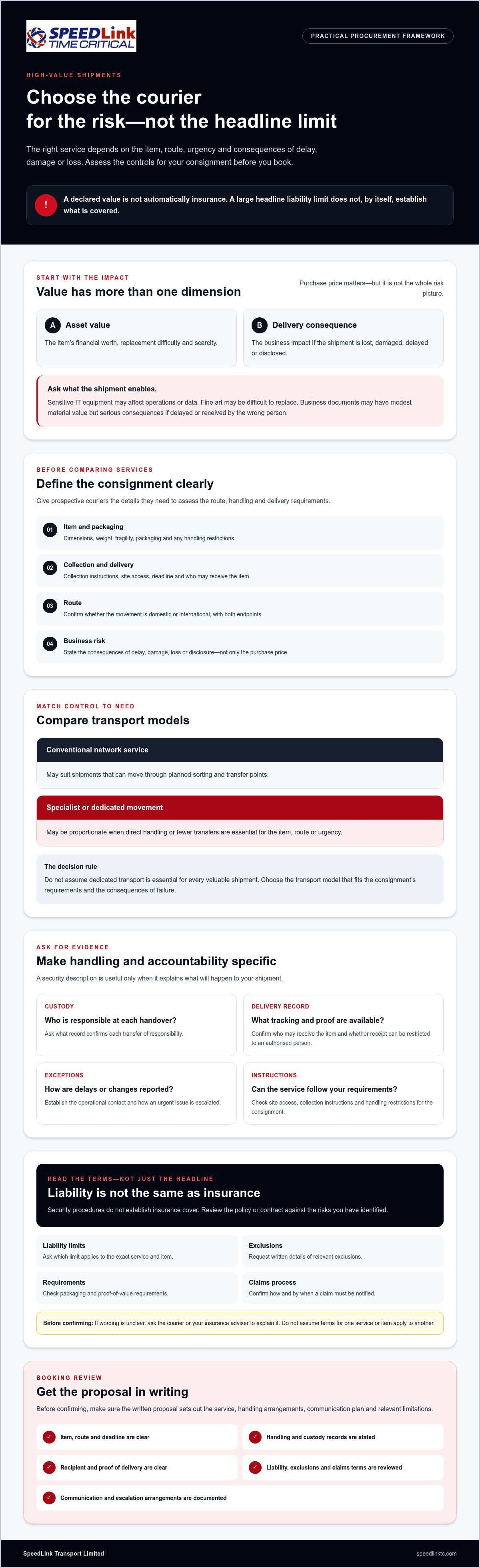
Use this procurement checklist before choosing a high-value courier
A consistent request for proposal makes it easier to compare what each supplier will actually provide. Before choosing a courier for high-value items, document the shipment’s requirements and ask for a written proposal that addresses them directly.
What to include in a courier request
- Describe the item: State what it is, its shipment value, dimensions, weight, fragility and any relevant sensitivity.
- Define the risk: Explain the consequences of loss, damage, delay or an unauthorised handover.
- Confirm the route: Provide collection and delivery addresses, required dates, access details and whether the journey is domestic or international.
- Specify handling and evidence: Set out restrictions, packaging responsibilities, collection and delivery contacts, handover expectations, and the proof your organisation needs.
- Request the service details: Ask the supplier to identify the proposed service, custody process, tracking and communication arrangements, escalation contact and any limitations.
- Review the terms: Check the applicable liability and insurance wording, exclusions, claim process and any conditions that affect your shipment.
How to make the final decision
Compare written proposals against operational risk, service fit, accountability and your stated budget. A lower-cost option may be suitable if its handling and delivery model meet your requirements. Additional controls are useful when they address a specific risk. Record agreed contingency instructions, including who should be contacted if access is unavailable or plans change.
Before authorising collection, confirm current availability and terms for the exact item, route and dates. If a same-day movement may fit your requirements, review SpeedLink’s same-day courier service and confirm the available option for your shipment.
Make the shipment decision with confidence
Choosing a courier for high-value items starts with the consequences of a failed delivery, not just the item’s price. Define the shipment’s risks, then compare transport options against its handling needs, route and urgency. Dedicated transport may be appropriate when its added control meets a specific requirement, but it isn’t automatically necessary.
Before booking, request a written proposal that explains custody records, handovers, communication, limitations and the terms that apply to liability and insurance. Confirm who will collect and receive the item, what evidence of delivery you need, and what happens if plans change.
SpeedLink offers secure courier services, with fine art transport and IT equipment logistics among its specialist services. Explain your shipment, origin, destination and requirements so the team can confirm current availability and suitable options.
A clear brief and documented proposal give your team a stronger basis for entrusting a valuable consignment to a courier.
Frequently Asked Questions
Is a dedicated courier always the safest choice for high-value items?
No. A dedicated service may suit requirements for direct movement or fewer transfers, but it isn’t automatically necessary or a guarantee against loss or damage. Assess the item’s sensitivity, route, urgency and the consequences of disruption, then compare the proposed handling and custody arrangements with those risks. A standard network service may be appropriate if its controls and terms meet your documented requirements.
Can a standard courier transport high-value business equipment?
Potentially, if the provider accepts the item and the specific service, handling procedures and terms suit the shipment. Check restrictions, packaging requirements, liability conditions and delivery evidence before booking. SpeedLink lists IT equipment and laptop courier services among its offerings, but availability depends on the shipment and route. Confirm the proposed arrangements for your equipment rather than assuming every service handles it in the same way.
What should I ask a courier before sending a high-value item?
Ask what service is proposed, how custody and handovers are recorded, what tracking and proof of delivery are available, and who will communicate or escalate an exception. Request the terms that apply to your item, including liability limits, exclusions and claim notification steps. Choosing a courier for high-value items should involve written, shipment-specific answers, not just a broad assurance that the service is secure.
Does courier insurance cover the full value of an item?
Not necessarily. Cover depends on the contract or policy, including its limits, exclusions and conditions. A declared value or carrier liability limit shouldn’t automatically be treated as an insurance policy or full-value protection. Ask what applies to the exact item and service, whether packaging conditions affect a claim, and how and when a claim must be reported. Seek clarification from the provider or your insurance adviser if the terms are unclear.
How do I choose between road freight, air freight and hand-carry?
Compare route, urgency, handling requirements and transfer points. Road freight may suit a journey where its route and schedule meet the need; air freight may be worth assessing for longer distances. Hand-carry can be considered for urgent or sensitive consignments if the route and service are feasible. Confirm current availability, journey arrangements and terms for the exact origin, destination and item before selecting a mode.

Article by
Dave McMillen
I have worked in courier and logistics for over 30 years. My experience spans two continents and several types of services from road freight to airlines and specialist B2B services. SpeedLink has been serving the UK market for over 20 years providing the finest time critical and specialist services supporting businesses and individuals alike.
Disclaimer
Information is provided as general logistics guidance and is not legal, customs, aviation, medical or dangerous-goods compliance advice.
Rules vary according to commodity, quantity, classification, packaging, origin, destination, transport mode and carrier.
Regulations and carrier requirements may change.
Where regulated goods are involved, current requirements should be confirmed with the appropriate government authority, regulator, carrier or qualified specialist before shipment.
SpeedLink can confirm the transport options it can provide for a particular shipment.


