


A laptop return courier service should be judged by more than its ability to collect a computer. Returns may include other IT equipment, so collection and handling arrangements should account for every item. Compare packaging, tracking, collection coverage and delivery options before choosing.
Getting a laptop back safely is only part of the task. Missing accessories, unsuitable packaging or a collection that does not reach the employee can leave the return incomplete. Clear instructions and shipment tracking help keep the process visible from handover to receipt.
This article explains how to assess those practical capabilities, including when a courier can support returns of additional IT equipment. You’ll see how different service approaches compare, what to consider for remote or international collections, and how to match the handling method to the shipment rather than defaulting to a more complex option than you need.
Key Takeaways
- Match packaging and tracking arrangements to the equipment being returned, and define how each handover will be recorded.
- Reduce retrieval friction by coordinating collection details, return instructions and a clear inventory of devices and accessories.
- Assess geographic coverage against both collection and delivery locations, especially when returns cross borders.
- Compare providers on their ability to handle additional IT equipment and organise return shipping that fits the shipment’s needs.
Secure packaging, tracking, and chain of custody
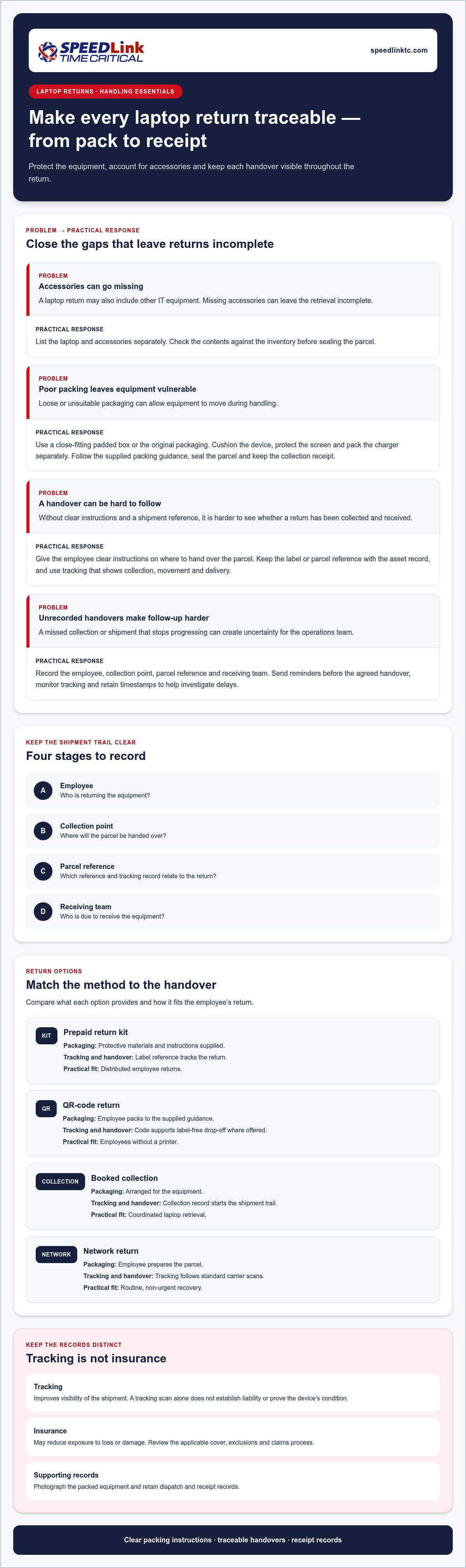
Start with the equipment and handover requirements, not just the shipping label. A return kit may include protective packaging, a prepaid label and employee instructions. The employee should follow the packing steps, seal the parcel and keep the collection receipt. For multiple items, use an inventory that lists the laptop and accessories separately.
What are the lithium battery shipping rules for returning a laptop by courier? Requirements depend on the route and transport mode. Identify the battery and its condition when arranging the shipment, then follow the courier’s instructions for packaging and shipment information.
Choose a return method that makes each stage visible. A prepaid label can simplify the employee’s task, but formats vary: some services provide a printed label, while others use a QR code. Send the label or code with clear instructions on where to hand over the parcel. Tracking should show collection, movement and delivery. Keep the reference with the asset record.
Maintain a clear chain of custody at every handover. Record the employee, collection point, parcel reference and receiving team. Send reminders before the agreed handover, then monitor tracking for a missed collection or stalled shipment. If the parcel stops progressing, the reference and timestamps help the operations team investigate.
Tracking and insurance address different risks. Tracking improves visibility, while insurance may reduce exposure to loss or damage. Review the applicable cover, exclusions and claims process. A tracking scan alone does not establish liability or prove the device’s condition. Photograph the packed equipment and retain dispatch and receipt records.
| Return option | Packaging | Tracking and handover | Practical fit |
|---|---|---|---|
| Prepaid return kit | Protective materials and instructions supplied | Label reference tracks the return | Distributed employee returns |
| QR-code return | Employee packs to supplied guidance | Code supports label-free drop-off where offered | Employees without a printer |
| Booked collection | Packaging arranged for the equipment | Collection record starts the shipment trail | Coordinated laptop retrieval |
| Network return | Employee prepares the parcel | Tracking follows standard carrier scans | Routine, non-urgent recovery |
Choose an option with clear packing instructions and traceable handovers through to receipt.
Enterprise laptop retrieval and return shipping
Remote offboarding works best when equipment retrieval is part of the asset-management workflow. Create a return record linking the employee, device serial number, collection address and expected accessories. Provide clear packing instructions and explain the collection process. This helps IT track outstanding assets and plan replacement deployments. A laptop return courier service should support these steps, not create a separate process.
How do I back up and erase personal data before returning a laptop? Copy personal files to an employer-approved location, then check that they open. Remove personal accounts and follow the organisation’s approved wipe procedure. Do not erase company data or reset the device if IT needs to complete that step.
For packing, use a close-fitting padded box or the laptop’s original packaging, with cushioning around the device. Protect the screen and prevent movement inside the parcel. Pack the charger separately, then check the contents against the return inventory before sealing. Poorly fitting packaging can leave equipment vulnerable during handling.
Domestic collections can be arranged from an employee’s home or workplace. For international returns, the origin and destination affect routing, paperwork and handling. Prepare an accurate item description and customs documents where required. For a laptop moving from an overseas employee to a UK office, record the destination details and shipment description accurately.
The cost of a service depends on the shipment and is provided after a quote request. Factors can include distance, package dimensions and weight, collection access, urgency, destination and customs support. Compare options for the same route and handling needs. A laptop return courier service may suit a planned return, while a more direct arrangement can help with time-sensitive retrieval.
- Routine return: use a consistent process for standard offboarding and monitor each device against its asset record.
- Time-sensitive return: select a more direct transport arrangement when a laptop is needed for redeployment or investigation.
- Cross-border return: coordinate shipment details and customs paperwork with the route.
For a planned return or time-sensitive retrieval, discuss the shipment requirements and align transport arrangements with your asset process.
Geographic coverage and local retrieval operations
Coverage means more than seeing a country on a service map. Check that collections reach employees’ actual locations and deliveries reach the required asset or IT hub. A provider may serve a destination without having a local office there. Record each origin, destination and preferred handover point before comparing routes.
Local operations can affect retrieval speed. International laptop retrievals with local operations usually take 4 to 7 business days. Treat this as a planning reference, not a universal transit time. Route, collection access, customs processing and handover arrangements all influence the movement. For cross-border returns, match the collection and delivery locations before selecting a service.
Compare the factors that affect cost rather than relying on a headline figure. Distance, parcel dimensions, collection access, service level and cross-border documentation can all matter. A prepaid label can simplify employee returns, but packaging, onward handling and asset processing still need consideration. Compare quotes using the same inventory and route assumptions.
Bulk retrieval requires a structured inventory. Group devices by employee, location and destination, then reconcile each collected item against the register. Linking updates to asset-management records can reduce manual work during a site closure or workforce transition. For collections from several offices, shipment references should map to individual devices, not only to a combined consignment.
Courier collection and certified disposal are separate stages. For end-of-life equipment, record the approved destination and retain disposal evidence, such as a certificate where the process provides one. A transport record shows movement, not data destruction or recycling.
- Coverage: assess collection reach and delivery reach separately.
- Operations: compare local collection arrangements, tracking visibility and inventory reconciliation.
- End-of-life handling: distinguish device transport from documented disposal.
- Integration: check how shipment records connect with asset-management workflows.
Select a provider whose coverage, retrieval process, shipment visibility and records suit your return programme.
Laptop return service provider capabilities
A provider may handle transport alone or coordinate a wider equipment return workflow. Compare the service scope with the items being returned: laptops, chargers, docks and monitors may need different packaging and inventory records. Clarify whether the service covers collection, transport, receipt and exceptions, or only transit. This determines how much work remains with your IT team.
For confidential equipment, define who manages the device after receipt. Returned laptops should be securely handled or wiped before reuse, redeployment or onward processing. Agree whether your IT team will perform the wipe, and record the device identifier and status at each handover. A courier tracking event confirms movement, not data erasure.
Review how the provider’s platform connects with your asset-management system. Useful records include employee details, device identifiers, collection status, delivery confirmation and exception notes. If updates must be copied manually, assign responsibility and define how discrepancies will be resolved. Reconcile the shipment reference against the asset register before closing an offboarding case.
Match the transport method to the urgency. A standard network service may suit routine returns, while a dedicated vehicle may be appropriate for a time-sensitive or coordinated collection. Air freight or hand-carry can meet different international or urgent requirements, but each adds complexity. Choose the simplest method that meets the deadline and handling needs.
Some services provide a loan device while an employee’s original laptop is being repaired. Treat this as separate from return transport: establish how the loan device is issued, tracked and returned. For end-of-life assets, distinguish transport from disposal. If the process requires certified destruction or recycling, identify the responsible processor and retain its certificate with the asset record.
- Scope: list every equipment type and service stage required.
- Visibility: compare shipment updates and asset-record integration.
- Handling: define receipt, data wiping, reuse and disposal responsibilities.
- Logistics: align transit method with urgency, route and shipment needs.
Choose a provider whose documented services match the full workflow, not just collection.
SpeedLink Transport Limited: Same Day Courier
SpeedLink Transport Limited can support time-critical laptop movements. Its Same Day Courier service is relevant when a device needs to move promptly between an employee, business site and nominated destination. For routine returns, consider the urgency, handling requirements and route when selecting a service.
For European movements, SpeedLink’s EU shipping with customs clearance service can support cross-border transport and the associated customs process. Arrangements depend on the origin, destination and shipment details. Returns involving multiple sites or a defined event schedule may also benefit from planned courier coordination.
Provide the collection and delivery locations, device details, required timing and any handling instructions. This gives SpeedLink’s operations team the information needed to plan a suitable transport arrangement without unnecessary complexity.
Contact SpeedLink Transport Limited to discuss your laptop return shipment.
Put the return plan into operation
Turn your provider comparison into a workable return process. Assign an owner to each stage, from employee instructions through to receipt and asset-register closure. Define what happens if a collection is missed, a parcel is delayed or equipment arrives incomplete. These decisions make future offboarding cycles easier to manage.
A laptop return courier service should meet operational needs without adding unnecessary steps. For returns involving an event site or coordinated equipment movements, SpeedLink Transport Limited’s Exhibition and Events Courier service may also be suitable. Plan transport around the equipment, locations and timing your team needs to manage.
Prepare the collection and delivery details, device inventory and handling instructions before arranging the shipment. With these essentials in place, your team can move from provider selection to a clear, accountable return workflow.
A considered plan gives your team a practical basis for managing future returns.
Frequently Asked Questions
Can retrieval services handle other IT equipment besides laptops?
Yes, retrieval services can include other IT equipment, such as monitors, docking stations, keyboards and chargers. Make an itemised list before booking, as dimensions and fragility affect packing and handling. SpeedLink Transport Limited offers IT Equipment Courier services for returns that include equipment beyond the laptop itself. Record each item against its asset identifier to simplify receipt checks.
How quickly can laptop retrievals happen internationally?
International retrievals handled through services with local operations usually take 4 to 7 business days. The overall schedule also includes arranging access with the employee, preparing the shipment and processing it at the receiving location. For planning, distinguish collection date from final receipt, then allow the IT team time to inspect the returned device and update its asset records.
How long should the entire return cycle take?
Set the return cycle around internal offboarding milestones, rather than treating transit as the only measure. Include employee notification, packing, collection, delivery, condition assessment and asset-register closure. For example, define completion as the point when the receiving team verifies the laptop’s serial number and records its status. This gives HR and IT a shared measure for closing each return case.
What packaging is required to safely ship a laptop by courier?
Use a sturdy, close-fitting box with cushioning to prevent the laptop shifting in transit. Protect the screen and corners, and keep the power adaptor separate. If the original packaging is available and intact, it may provide a suitable fit. Include a contents list inside the parcel, but keep personal or confidential information off the outer packaging.
Should I insure a laptop return shipment, and what are courier liability limits?
Consider insurance for the device’s replacement value, and review the courier’s liability terms separately. Carrier liability and shipment insurance are not interchangeable: they may have different limits, exclusions and evidence requirements. Before dispatch, record the laptop’s serial number and condition, keep proof of collection, and note how to report loss or damage. These records can support an accurate claim if a problem occurs.
How can I track a laptop return and confirm the retailer received it?
Use the shipment reference to follow scans, then retain the final delivery confirmation with the return record. If a retailer is receiving the laptop, match its proof of delivery against the parcel reference and device serial number. A delivery scan confirms arrival at an address, but not necessarily that the correct item has been checked in. Request or retain the recipient’s intake confirmation as a separate record.

Article by
Dave McMillen
I have worked in courier and logistics for over 30 years. My experience spans two continents and several types of services from road freight to airlines and specialist B2B services. SpeedLink has been serving the UK market for over 20 years providing the finest time critical and specialist services supporting businesses and individuals alike.
Disclaimer
Information is provided as general logistics guidance and is not legal, customs, aviation, medical or dangerous-goods compliance advice.
Rules vary according to commodity, quantity, classification, packaging, origin, destination, transport mode and carrier.
Regulations and carrier requirements may change.
Where regulated goods are involved, current requirements should be confirmed with the appropriate government authority, regulator, carrier or qualified specialist before shipment.
SpeedLink can confirm the transport options it can provide for a particular shipment.


