


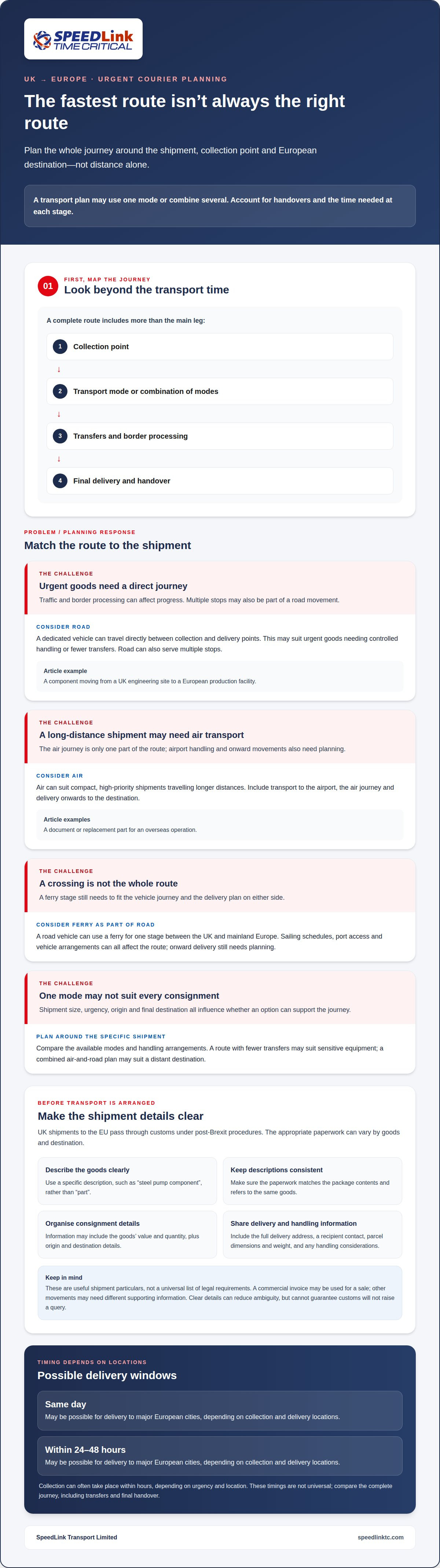
The fastest route isn’t always the right route for an urgent courier from the UK to Europe. Same-day delivery or delivery within 24-48 hours may be possible, depending on the collection and delivery locations. The transport plan also depends on the shipment and the paperwork needed for its journey.
When a delivery is time-critical, speed matters, but the right option depends on the whole journey, not just the distance. Clear shipment details and prepared customs documents help establish the route requirements and keep arrangements focused.
This article explains how urgent courier movements from the UK to Europe are organised, which transport options may suit different requirements, and what customs and export information may be needed. It also shows how the destination and shipment details shape the plan, helping you identify practical next steps.
Key Takeaways
- Understand why UK-to-EU shipments pass through customs and which shipment details help shape the paperwork.
- Learn how export documentation supports a cross-border movement and what can affect the process.
- Compare air, road, ferry and rail options to see how urgency, cargo and destination influence route planning.
- Use the destination and shipment requirements to identify a suitable delivery approach for your European consignment.
What documents are required for shipping to the EU post-Brexit?
UK shipments to the European Union pass through customs under post-Brexit procedures. Shipment information should give a clear, consistent account of what is being sent and where it is going.
Customs procedures and shipment documents
Prepare a description of the goods, their value and quantity, and the sender’s and recipient’s details. These are useful shipment particulars, not a universal checklist of legal requirements. For example, “steel pump component” is clearer than “part”. Keep the information consistent wherever it appears, so the shipment is described clearly throughout its journey.
Paperwork can vary with the goods and destination. A commercial invoice may be used to describe a sale, while other movements may have different supporting information. Customs support for EU shipments can help coordinate paperwork with transport arrangements.
International shipment requirements
Organise the information around the specific consignment. Include an accurate description of the contents, the full delivery address and a contact for the recipient. Describe any handling considerations plainly. These details help those arranging transport understand the shipment, without assuming one set of documents suits every item or route.
Tracking, insurance, delivery guarantees and proof of delivery are separate service features. Tracking and proof of delivery can provide progress and handover information; insurance or extended liability depends on the cover arranged. Do not assume a delivery guarantee unless the agreed service expressly includes one.
No single size or weight limit applies to every urgent international courier arrangement. Provide the parcel’s dimensions and weight, as these affect handling and transport suitability.
Delivery to major European cities may be available on the same day or within 24-48 hours, depending on collection and delivery locations. Collection can often take place within hours, depending on urgency and location. Tracking updates can help teams follow progress; proof of delivery records the completed handover.
Customs documentation and export requirements
Prepare shipment information that gives a clear, consistent account of the goods and their journey. The documents and details required can vary by consignment and destination.
Customs descriptions and delay prevention
Use a specific, plain-language description rather than a vague label. For example, “replacement control unit” is clearer than “equipment”. Use the same description wherever the shipment is documented, and make sure the paperwork matches the package contents. This helps reduce ambiguity, but cannot guarantee that customs will not raise a query.
Shipment information might include the goods’ description, value and quantity, as well as origin and destination details. Treat these as details to organise, not a universal list of required documents. A commercial invoice may be relevant to a sale, while another type of movement may require different paperwork. The circumstances of the shipment determine what information is appropriate.
Customs clearance documentation
Keep documents for the consignment together and make sure their descriptions refer to the same goods. If a package contains several different components, for example, distinguish them rather than using a broad category. This gives the person arranging transport a coherent shipment record and helps avoid resolving discrepancies between documents.
If a shipment is delayed, held at customs or undeliverable, establish the recorded reason and the next required action. The movement may pause while information is clarified; an undeliverable item may need different arrangements depending on the circumstances. Don’t assume an automatic return or redelivery. For help coordinating paperwork with the transport plan, discuss the shipment and its documentation.
Air, road, ferry and rail transport options
The right transport plan depends on the shipment, collection point and European destination. An urgent delivery may use one mode or combine several, such as a road vehicle linking a UK collection with an airport. The route must also account for handovers and the time needed to complete each stage.
Road: A dedicated vehicle can travel directly between collection and delivery points, which can suit urgent goods that need controlled handling or fewer transfers. For example, a component travelling from a UK engineering site to a European production facility may benefit from a direct road movement. Road transport can also serve multiple stops, although traffic and border processing may affect progress.
Air: Air transport can suit compact, high-priority shipments travelling longer distances. The plan must include transport to the airport, the air journey and onward delivery to the destination. For example, a document or replacement part for an overseas operation could travel by air. Account for airport handling and connecting movements when planning the route.
Ferry: A road vehicle can use a ferry as one stage of its journey between the UK and mainland Europe. The shipment remains part of a road-led plan, with the crossing forming a separate transport stage. Sailing schedules, port access and vehicle arrangements all affect the route, so a ferry crossing does not remove the need to plan onward delivery.
Other transport options: The available modes and handling arrangements must suit the shipment. A courier service can consider the route and transport options available rather than assuming every shipment suits the same mode. The shipment’s size, urgency, origin and final destination determine whether a particular option can support the required journey.
For an import with a firm operational deadline, compare the complete journey, not just time in transit. Identify the collection, transport mode, transfer points and final handover. A route with fewer transfers may suit sensitive equipment, while a combined air-and-road plan may work better for a distant destination. Factor expected border and handling delays into the decision.
Countries and territories served
European delivery planning starts with the precise destination address. A country name alone does not identify the receiving site, access arrangements or final handover point. For a business shipment, record the full address, postcode, organisation name and recipient’s contact details. These particulars help define the movement without assuming every route has the same service arrangements.
Site access can change the delivery plan. A staffed business premises may receive a consignment differently from a construction site, exhibition venue or facility with controlled entry. Include opening hours, booking procedures and vehicle access instructions with the destination details. If the site requires a named recipient, provide their details before dispatch.
Remote destinations need particular attention to the final leg. A rural address, island location or site away from established transport links may require different routing and handover arrangements from a centrally located business address. Describe the destination precisely, rather than simply as “Europe” or by a broad regional label.
For an urgent delivery, establish the required arrival date and confirm that the recipient can accept the shipment. A delivery window outside the site’s receiving hours can affect the practical plan, even if the transport route is suitable. Event consignments also benefit from venue instructions, booking references and a responsible contact to receive the goods.
To assess a European movement, bring together the UK collection address, full destination address, shipment details and receiving requirements. This gives the route plan a clear operational basis and helps identify destination-specific considerations, without assuming coverage or handling arrangements are identical in every territory.
Pay particular attention to rural addresses, islands and sites away from established transport links, as well as construction sites, exhibition venues and facilities with controlled entry. These may require different routing, handover, access or booking arrangements.
SpeedLink Transport Limited
SpeedLink Transport Limited helps businesses plan urgent shipments from the UK to Europe, aligning the transport option with the route, cargo and deadline. Its Same Day Courier and EU shipping with customs clearance services support movements where prompt delivery and cross-border paperwork need to be considered together.
For a practical assessment, provide the collection and delivery addresses, shipment description, dimensions, weight and required delivery date. Include details of any customs documents already prepared and any constraints at the collection or delivery site. This information helps establish the transport requirements and identify documentation considerations before the movement is arranged.
For event-related consignments, SpeedLink’s Exhibition and Events Courier service may also be relevant. Contact SpeedLink to discuss your shipment and route.
Plan the next movement with confidence
For an urgent courier from the UK to Europe, turn the shipment’s priorities into a clear transport brief. Set out the collection and delivery points, the nature of the goods, the required delivery date and any site or handover constraints. This gives the planning conversation a practical starting point, especially when an operational deadline depends on a specific component or document arriving.
SpeedLink offers Same Day Courier, EU shipping with customs clearance, and Exhibition and Events Courier services. The appropriate service depends on the shipment’s purpose and requirements, not urgency alone. Share the details that will shape the movement so the team can discuss a suitable approach, rather than assuming every consignment needs the same route.
A well-defined brief is a practical first step towards organising your European delivery. Contact SpeedLink to discuss your shipment and plan the movement.
Frequently Asked Questions
How does same-day European courier service work?
An urgent courier UK to Europe movement is planned around the collection point, destination and shipment requirements. A dedicated road journey may suit a direct route, while air transport can be considered for longer distances or specific deadlines. The plan also accounts for handovers and site access. Same-day delivery depends on whether the complete route can be arranged within the required timeframe.
Where does same-day European delivery apply to?
Same-day delivery is suitable for European routes that can be completed within the transport plan. Coverage is route-specific, so the collection address, full destination address and required arrival time matter more than the country name alone. For example, a business park outside a city may involve different access and final-mile arrangements from a central office. Share both addresses to establish the appropriate route.
Are there any restrictions on the type of goods that can be delivered to Europe?
Yes. Goods must be suitable for the selected transport and destination requirements. Items such as lithium batteries, fine art and IT equipment may need specialist handling. Dangerous goods can only be transported when their classification, packaging and transport requirements are suitable for the service. Provide an accurate description of the contents, including any handling considerations, before arranging the shipment.
Can I track my shipment in real time?
Contact SpeedLink to confirm the tracking options available for your shipment, origin and destination. For example, a business team may need to coordinate with a receiving site to prepare staff to accept an urgent replacement laptop. The recipient’s contact details and delivery instructions should be accurate throughout the movement.
Do shipments to the European Union travel through customs?
Yes. Shipments travelling from the UK to the European Union pass through customs procedures. This applies whether the consignment is a document, a replacement component or equipment for an event. Customs clearance forms part of the cross-border movement, so the paperwork should clearly describe the shipment’s contents and destination. Customs processing is separate from the transport leg itself.
How does it work?
Start by providing the collection and delivery addresses, a description of the goods, their dimensions and weight, and the required delivery date. The shipment can then be matched to an appropriate transport arrangement. For example, an event organiser sending display equipment should include the venue’s delivery instructions and receiving contact. An urgent courier UK to Europe booking can then be planned around those operational details.

Article by
Dave McMillen
I have worked in courier and logistics for over 30 years. My experience spans two continents and several types of services from road freight to airlines and specialist B2B services. SpeedLink has been serving the UK market for over 20 years providing the finest time critical and specialist services supporting businesses and individuals alike.
Disclaimer
Information is provided as general logistics guidance and is not legal, customs, aviation, medical or dangerous-goods compliance advice.
Rules vary according to commodity, quantity, classification, packaging, origin, destination, transport mode and carrier.
Regulations and carrier requirements may change.
Where regulated goods are involved, current requirements should be confirmed with the appropriate government authority, regulator, carrier or qualified specialist before shipment.
SpeedLink can confirm the transport options it can provide for a particular shipment.


