


In 2026, the success of your global supply chain no longer depends on finding the cheapest carrier, but on navigating a regulatory environment where a single customs oversight can halt an entire production line. With air freight rates from London Heathrow rising by over 24% in late 2026, you likely feel the mounting pressure of tightening margins and the persistent frustration of unpredictable border delays. It’s particularly challenging whilst trying to manage high-value IT assets or sensitive fine art that requires specialist care. This guide provides the strategic framework you need to master 2026 customs regulations, secure your most specialised goods, and restore total predictability to your delivery timelines. We will examine the practical impact of ICS2 Phase 3 and the Carbon Border Adjustment Mechanism (CBAM) on your shipments. By the end, you’ll understand how a more methodical approach to international freight UK operations can transform logistics from a source of risk into a distinct competitive advantage for your business.
Key Takeaways
- Understand the strategic shift in international freight UK for 2026, moving beyond commodity shipping toward a focus on operational precision and global trade corridor stability.
- Identify the specific documentation and 2026 customs requirements needed to bypass border bottlenecks and maintain predictable delivery timelines for EU shipments.
- Learn the specialised handling protocols required for high-value IT equipment and sensitive cargo to mitigate the risk of damage during transit.
- Establish a robust framework for vetting logistics partners based on security clearances and their ability to provide real-time expert support for complex movements.
Navigating the Complexity of International Freight UK in 2026
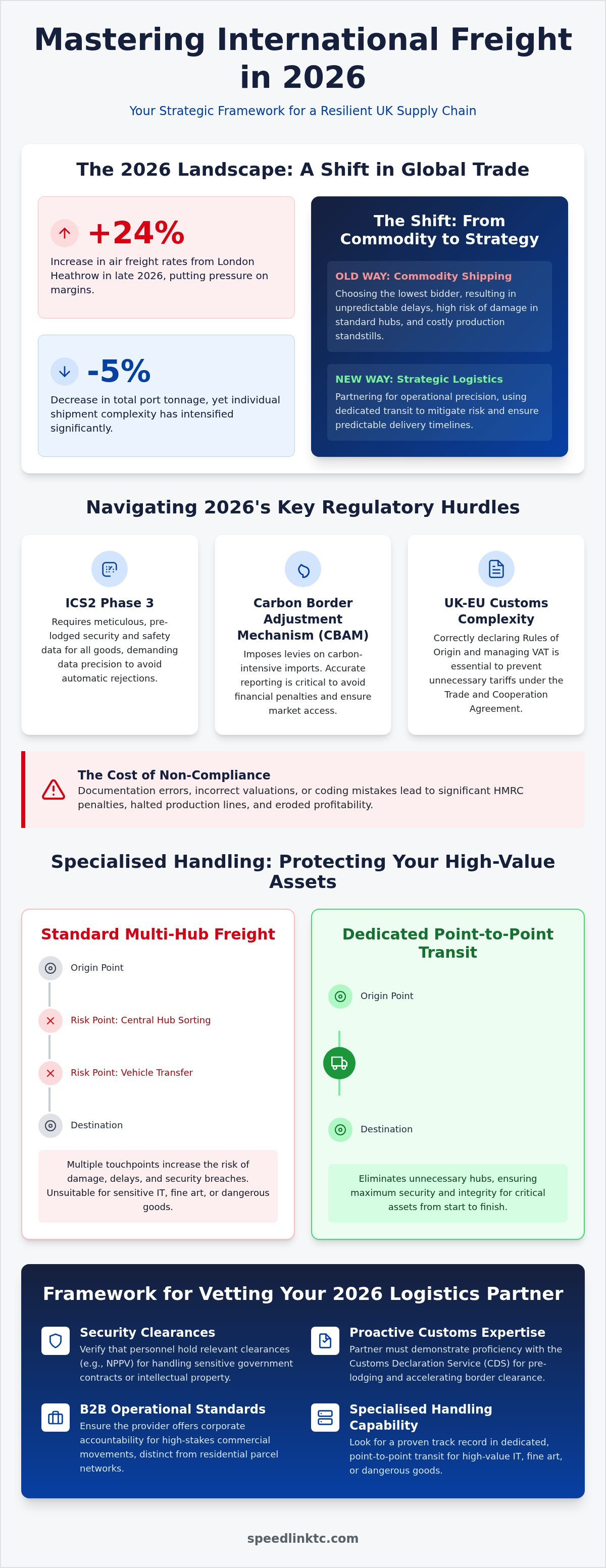
International freight UK represents the strategic movement of commercial goods across borders, a process that has become increasingly sophisticated. As we move through 2026, the logistics landscape is defined by a unique tension between post-Brexit regulatory stability and the volatility of new global trade corridors. Whilst total port tonnage saw a 5% decrease in the second quarter of 2026, the complexity of individual movements has intensified. Maintaining UK supply chain integrity now requires a proactive stance on time-critical delivery, ensuring that components arrive exactly when needed to avoid costly production standstills.
The Shift from Commodity Shipping to Strategic Logistics
The era of choosing the lowest bidder in a generic marketplace is ending. Business leaders now recognise that the cheapest quote often results in the most expensive delays, especially when global freight transport networks face ongoing port congestion. Instead of hoping for space on a crowded vessel, firms are opting for dedicated courier services. This strategic choice provides a direct line of sight for your cargo, significantly reducing transit risk by bypassing the high-touch environments of standard freight hubs where damage is most likely to occur.
B2B Requirements: Why Professional Standards Matter
Professional logistics must be distinguished from residential parcel delivery. The latter lacks the rigorous corporate accountability required for high-stakes commercial movements. B2B international freight UK operations demand a methodical approach to security and vetting. If your shipments involve sensitive intellectual property or government contracts, your provider must offer NPPV cleared personnel. We believe that true operational authority comes from this level of precision, where every driver and handler is vetted to meet the highest security standards. This ensures that your specialised goods are managed by experts who understand the weight of your corporate requirements.
Strategic Customs Clearance: The Key to Borderless Trade
Customs clearance remains the primary bottleneck in international freight UK operations. In 2026, the complexity of border movements has intensified due to the final implementation of ICS2 Phase 3 and the full operation of the Carbon Border Adjustment Mechanism (CBAM). These frameworks require meticulous data precision before goods even reach the port. Errors in commodity coding or valuation don’t just cause delays; they invite significant HMRC penalties that can erode the profitability of a shipment. By integrating professional customs expertise into your logistics strategy, you ensure that compliance is a facilitator of trade rather than a barrier to it.
Navigating EU Shipping with Customs Clearance
The UK-EU border presents unique challenges, particularly regarding rules of origin and VAT accounting. Common errors, such as missing Statements on Origin, frequently result in standard WTO tariffs being applied unnecessarily. Utilising integrated customs services allows your business to outsource this complexity to seasoned specialists who understand the nuances of the Trade and Cooperation Agreement. For a comprehensive breakdown of these specific requirements, refer to our guide on EU shipping with customs clearance.
Mitigating Delays with Pre-Cleared Logistics
Efficiency in 2026 depends on pre-lodging declarations through the Customs Declaration Service (CDS) to accelerate transit times. This approach aligns with current UK international road transport regulations, which demand stricter pre-arrival security data for all modes of transport. Incoterms 2020 remain the definitive standard for defining buyer and seller responsibilities in 2026 freight contracts. If you are unsure how these regulations impact your current routes, you can request a strategic customs review from our team. We focus on getting the documentation right the first time, ensuring your international freight UK movements remain seamless and compliant.
Specialist Handling for High-Value and Sensitive Cargo
Standard international freight UK solutions often fail when tasked with high-value assets because they rely on multi-hub networks. Every time a crate is moved between vehicles or sorted in a central hub, the risk of mechanical damage or security breaches increases. For sensitive IT equipment and high-value hardware, we eliminate these unnecessary touchpoints through dedicated, point-to-point transit. This methodical control ensures that your critical infrastructure remains secure and fully functional upon arrival, bypassing the chaotic environments of generic sorting centres.
Handling dangerous goods requires more than just basic compliance; it demands an active understanding of the evolving legal landscape in 2026. Whether you are transporting industrial chemicals or delicate fine art for an international exhibition, the logistics must be tailored to the specific risk profile of the cargo. Niche requirements for fine art involve climate-controlled environments and white-glove delivery, services that generic freight forwarders simply cannot replicate with their standardised processes. We treat these movements as high-stakes missions where precision is the only acceptable outcome.
Lithium Batteries and Hazardous Materials
In 2026, the regulations surrounding lithium battery transport have become exceptionally stringent to prevent thermal events during transit. Standard carriers often refuse these items or apply prohibitive surcharges without offering the necessary security guarantees. We utilise ADR-trained couriers who possess the specific expertise required for hazardous international freight UK movements. If you are moving volatile components or high-capacity power cells, you can find detailed protocols in our specialist courier guide. This level of precision is non-negotiable for maintaining corporate safety standards and avoiding regulatory friction. To secure your high-value assets with a vetted logistics partner, contact our specialist handling team today.
Optimising Your Supply Chain with Reliable Freight Partners
Selecting a partner for international freight UK is a decision that directly impacts your operational resilience. In a market where price transparency often masks a lack of service depth, we believe that long-term reliability is built on rigorous vetting and a commitment to security. A truly strategic partner doesn’t just move boxes; they act as a consultant, ensuring that every movement aligns with your corporate standards and 2026 regulatory obligations. This proactive approach allows you to transition from reactive shipping to a controlled, methodical logistics strategy that protects your margins and your reputation.
Criteria for Choosing a B2B Logistics Partner
When evaluating potential partners, security clearances must be your first checkpoint. For businesses handling sensitive data, intellectual property, or government-related hardware, NPPV cleared courier services are essential to maintain document confidentiality and physical asset security. Beyond vetting, you must assess their capability to execute the “Special Services” your industry requires. If a provider cannot demonstrate proven experience with hazardous materials or exhibition logistics, they aren’t equipped to manage the high-stakes complexities of modern international trade. We prioritise a collaborative approach, ensuring our drivers and handlers are fully vetted to meet these professional standards.
Next Steps: Securing Your 2026 Freight Strategy
To ensure a seamless freight collection, your business should prepare by finalising all commercial invoices and ensuring packaging meets international transit standards. We apply a “Same Day” philosophy to our global movements, treating every international consignment with the same urgency as a local time-critical delivery. This mindset reduces dwell times at hubs and keeps your supply chain moving with precision. The final step in mastering your 2026 operations is to move beyond generic, hub-based solutions. We invite you to request a professional consultation for your international freight to discuss your specific requirements and secure your global routes with seasoned experts.
Mastering Your Global Logistics Strategy for 2026 and Beyond
Navigating the landscape of international freight UK requires more than just a transport provider; it demands a strategic partner capable of managing the intersection of regulatory compliance and operational security. We’ve explored how moving away from generic hub-based networks in favour of dedicated, point-to-point transit reduces risk for your most sensitive assets. By prioritising NPPV cleared personnel and expert customs clearance support, your business can bypass the common bottlenecks that define modern border movements. Whether you’re managing complex IT infrastructure or require specialist dangerous goods handling, the key to resilience lies in methodical control and proactive planning. Transitioning to a professional logistics framework ensures that your supply chain remains a reliable engine for growth rather than a source of disruption. It’s time to secure your global routes with the precision your corporate standards demand. We invite you to discuss your international freight requirements with our experts to build a more predictable future for your business.
Frequently Asked Questions
What is the difference between international freight and a standard courier?
International freight UK services typically involve larger, commercial-scale shipments handled through global networks, whilst standard couriers focus on smaller, individual parcels. For time-critical business needs, we bridge this gap by providing dedicated freight solutions that offer the speed of a courier with the capacity of a strategic logistics operation. This approach ensures that your business-critical cargo isn’t subjected to the dwell times and damage risks typical of generic consumer sorting centres.
How has customs clearance changed for UK businesses in 2026?
Customs clearance in 2026 requires mandatory pre-lodgement and precise data submission through the Customs Declaration Service (CDS). The final phase of ICS2 now mandates comprehensive pre-arrival security data for all transport modes entering the EU. We manage these complex administrative requirements as part of our integrated service, ensuring that your international freight UK movements remain compliant with current HMRC standards whilst avoiding the bottlenecks and penalties associated with incorrect commodity classifications.
Can I send dangerous goods like lithium batteries via international freight?
Yes, you can transport dangerous goods, including lithium batteries, provided you use a specialist logistics provider with ADR-trained personnel. Regulations in 2026 are exceptionally strict regarding the packaging and declaration of hazardous materials to prevent transit incidents. We offer dedicated lithium battery courier services that comply with all current safety protocols, ensuring your high-capacity power cells or volatile components are moved securely across borders without risking regulatory friction or carrier rejection.
Why should I choose a dedicated courier for high-value IT equipment?
A dedicated courier for high-value IT equipment eliminates the risks found in multi-hub parcel networks. Standard shipping involves multiple touchpoints where sensitive hardware is frequently handled by various personnel, increasing the likelihood of damage or security breaches. Our point-to-point service ensures your cargo remains on a single vehicle with vetted, NPPV cleared drivers. This methodical control is essential for protecting intellectual property and maintaining the operational integrity of critical business infrastructure.
Does SpeedLink handle residential parcel deliveries for international freight?
No, we are a specialist B2B logistics provider and explicitly do not handle residential parcel deliveries. Our operational model is designed for the rigorous requirements of corporate clients, including time-critical movements, secure document transport, and specialised freight. By focusing exclusively on the business-to-business sector, we ensure that our resources, such as NPPV cleared personnel and customs experts, are always available to manage high-stakes commercial consignments without the complexities of high-volume consumer shipping.

Article by
Dave McMillen
I have worked in courier and logistics for over 30 years. My experience spans two continents and several types of services from road freight to airlines and specialist B2B services. SpeedLink has been serving the UK market for over 20 years providing the finest time critical and specialist services supporting businesses and individuals alike.


