


The fastest-looking option isn’t always the right one. A delayed component, document or device can put business operations at risk, but choosing an emergency courier service UK businesses can rely on starts with the actual deadline and the consequences of missing it.
It’s natural to focus on speed when a shipment is urgent. Yet the right approach depends on more than urgency: size, handling requirements, destination and any security needs can all affect the transport choice. A dedicated vehicle may suit one movement, whilst another may be better served by a different delivery method.
This guide explains how to assess the urgency and requirements of a shipment, compare proportionate transport approaches and prepare a clear brief for your courier. You’ll learn which details help the team assess the route and handling needs, so the response can be shaped around the shipment rather than assumptions.
Key Takeaways
- Separate the business deadline from the preferred delivery time so you can judge how urgent the movement truly is.
- An emergency courier service uk request should match the transport approach to the route, cargo sensitivity and handling requirements.
- Prepare accurate collection and delivery addresses, site access details, named contacts and clear cargo information before arranging the movement.
- SpeedLink can assess the deadline, route and shipment requirements together to help identify a proportionate courier approach.
What UK Emergency Couriers Do for Businesses
An emergency courier is a shipment-specific response to a business-critical deadline. The aim is to match the movement to the operational need, cargo and route, rather than treat every urgent request as requiring the same level of intervention. An emergency courier service uk arrangement may support a production team waiting for a component, a legal professional sending time-sensitive paperwork or an operations team replacing essential IT equipment.
That decision sits within wider logistics, where the movement of goods must fit the needs of the organisation receiving them. SpeedLink’s same-day courier service is one relevant option for business shipments with a tight delivery requirement.
When does an urgent shipment become business-critical?
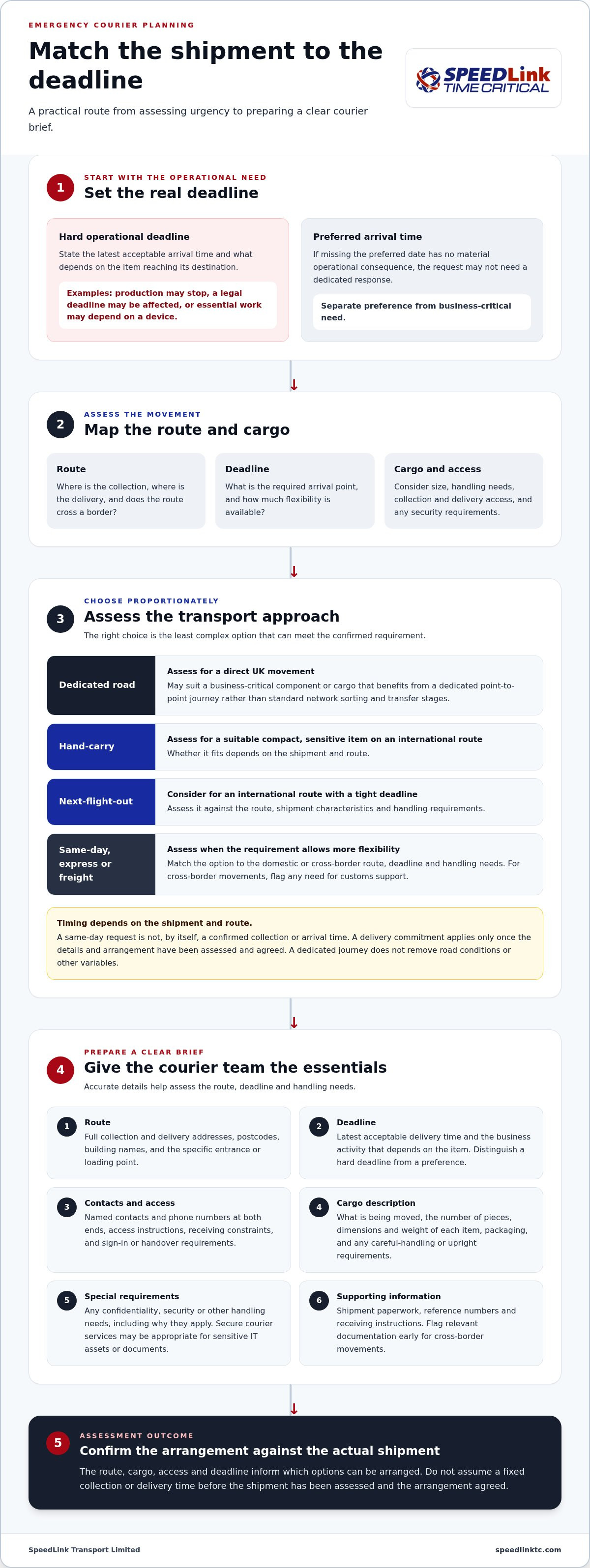
Assess what happens if the item misses its required arrival point. If a production process stops, a legal deadline is affected or a team cannot complete essential work without a device, the recipient’s dependency makes the shipment time-critical. By contrast, a preferred delivery date with no material operational consequence may be urgent in the everyday sense, but not an emergency requiring a dedicated response.
What an emergency courier cannot promise in advance
Urgent need, same-day delivery and a confirmed delivery commitment are different things. Same-day describes the requested service timeframe; it doesn’t, by itself, confirm a collection or arrival time. A delivery commitment applies only once the shipment details and arrangement have been assessed and agreed. Timings depend on the shipment details and route, so no fixed collection or delivery time should be assumed before that assessment.
Cargo dimensions, handling needs, collection and delivery points, site access and route all influence the options. A direct road movement may suit some UK shipments, whilst sensitive or specialist cargo can require additional handling considerations. Share the actual deadline and the consequence of missing it; that gives the courier a practical basis for assessing the movement and communicating what can be arranged.
Which emergency courier approach fits the shipment and deadline?
Match the transport method to the route, delivery deadline and cargo requirements. A direct UK movement may suit dedicated road transport, whilst an international shipment with a narrow delivery window may merit assessment for air freight or hand-carry. The right choice is the least complex option that can meet the confirmed requirement.
| Shipment need | Route and deadline | Approach to assess |
|---|---|---|
| Business-critical component | Direct movement within the UK | Dedicated road transport, particularly if avoiding a standard network journey matters |
| Compact, sensitive item | International route with a tight deadline | Hand-carry or next-flight-out, depending on the shipment and route |
| Less immediate requirement | Domestic or cross-border route with more flexibility | Same-day, express or freight options matched to the deadline and handling needs |
When is dedicated road transport appropriate?
When might air freight or hand-carry be considered?
For an international urgency, assess the origin, destination, deadline, cargo characteristics and handling needs together. Air freight may merit consideration where the route and shipment suit air transport; hand-carry may be assessed for suitable items requiring an accompanied movement. Cross-border shipments may also require customs support. For an emergency courier service uk team coordinating a specific movement, the mode should follow the confirmed requirements, not urgency alone.
Share the route and shipment brief with SpeedLink’s courier team to discuss a proportionate approach.
What information should you prepare before arranging an emergency courier?
A concise, accurate brief helps the courier team assess the route, deadline and handling needs without avoidable follow-up. Prepare the essentials in this order, starting with where the shipment must travel and when it needs to arrive.
- Route: Give the full collection and delivery addresses, including postcodes, building names and the specific entrance or loading point.
- Deadline: State the latest acceptable delivery time and explain what business activity depends on the item. Distinguish a hard operational deadline from a preferred arrival time.
- Contacts and access: Provide named contacts at both ends, their phone numbers, site access instructions, opening or receiving constraints, and any sign-in or handover requirements.
- Cargo description: Explain what is being moved, how many pieces there are, and the dimensions and weight of each item. Include packaging details and whether anything needs to remain upright or be handled carefully.
- Special requirements: Identify confidentiality, security or other handling needs, and say why they apply. For sensitive IT assets or documents, consider whether secure courier services are appropriate.
- Supporting information: Mention any shipment paperwork, reference numbers or instructions the receiving site needs to accept the goods. For cross-border movements, flag relevant documentation early.
Make the brief operational
Match handling to the actual risk
Flag sensitive or confidential cargo before arrangements are made, not at handover. Explain the concern, such as access to an IT device or the need to protect legal paperwork from unnecessary exposure. An emergency courier service uk request is easier to assess when handling instructions are specific and proportionate to the item.
How can SpeedLink help coordinate an emergency courier movement?
SpeedLink works with businesses to turn an urgent transport need into a clear operational decision. The discussion can help establish which proposed service fits the requirement and what the business needs to approve before proceeding. This gives logistics and operations teams a basis for coordinating internally, rather than treating urgency alone as authorisation to dispatch.
A practical conversation focused on the shipment
Use the discussion to clarify the proposed arrangement, including what it covers and what assumptions it depends on. If a delivery deadline is critical, distinguish the required outcome from any estimated timing, and make sure the people responsible for authorising the movement understand that distinction. Clear expectations help prevent different teams from working to different interpretations of the plan.
Keep ownership clear, too. Decide who within your organisation will approve the arrangement and who will communicate any changes to the relevant teams. That simple decision can reduce internal delays once the transport approach has been discussed.
Move from urgent requirement to next steps
Before authorising the movement, make sure the agreed service, responsibilities and delivery expectations are understood by the teams involved. If the operational situation changes, pass on the new information promptly so the plan can be reconsidered in context. Shipment options depend on the origin, destination and requirements.
For a considered next step, share your requirement with SpeedLink and discuss the transport arrangement for your business.
Prepare your next move with confidence
Consider setting an internal escalation process before a disruption occurs. Agree who can approve an emergency courier service uk movement and when operations or procurement should be brought in. A clear decision path can help your team act deliberately when an unexpected transport need arises.
Put that process into practice by discussing your next time-critical requirement with SpeedLink.
With responsibilities clear, your team can approach urgent transport decisions with greater confidence.
Frequently Asked Questions
What qualifies as an emergency courier delivery for a business?
Use your organisation’s escalation criteria to judge whether a transport issue needs an emergency response. Consider whether the requirement needs approval from an operations lead, procurement or another decision-maker, and who can authorise the response if the usual contact is unavailable. Establishing that responsibility in advance can help your team make a timely decision without treating every urgent request as an operational emergency.
How quickly can an emergency courier collect and deliver a shipment?
There’s no universal collection or delivery time for emergency movements. Before relying on a proposed timing, make sure it has been explicitly agreed for the specific booking. Also check that the goods will be released and ready at the collection point, and that the receiving site can accept them at the planned arrival. Unready cargo or an unavailable recipient can undermine an otherwise workable transport plan.
Is a dedicated courier always the right choice for an urgent delivery?
No. The transport decision also has an internal approval dimension: if a more specialised option may be needed, involve the relevant budget holder or operational lead early. Weigh the importance of the deadline against the consequences of delay, then agree who can approve the proposed approach. This helps the team avoid selecting a higher-complexity movement by default or losing time to unresolved sign-off.
What details should I give an emergency courier when booking?
Check that shipment records agree before passing information to the courier. The description on dispatch paperwork, package labels and any internal reference should identify the same goods, particularly if a receiving team uses that reference to allocate or release the item. If the records differ, nominate someone who can resolve the discrepancy promptly, so it doesn’t create uncertainty during collection or receipt.
Can an emergency courier transport sensitive or specialist business items?
That depends on the item and the handling it needs. Be specific about the type of sensitivity: confidentiality, physical fragility and specialist transport constraints are different concerns and may call for different instructions. For example, “confidential” explains an information risk, whilst “fragile” describes a physical one. Clear wording helps the transport discussion focus on relevant precautions rather than relying on a general label.

Article by
Dave McMillen
I have worked in courier and logistics for over 30 years. My experience spans two continents and several types of services from road freight to airlines and specialist B2B services. SpeedLink has been serving the UK market for over 20 years providing the finest time critical and specialist services supporting businesses and individuals alike.
Disclaimer
Information is provided as general logistics guidance and is not legal, customs, aviation, medical or dangerous-goods compliance advice.
Rules vary according to commodity, quantity, classification, packaging, origin, destination, transport mode and carrier.
Regulations and carrier requirements may change.
Where regulated goods are involved, current requirements should be confirmed with the appropriate government authority, regulator, carrier or qualified specialist before shipment.
SpeedLink can confirm the transport options it can provide for a particular shipment.


